What is an AI knowledge base?
An AI knowledge base is a central place where your documents become searchable by meaning, so anyone on your team can ask a question in plain language and get a direct, cited answer instead of a list of files to open. Unlike a traditional wiki or shared drive, it uses semantic search and a large language model to understand intent, retrieve the most relevant passages, and answer with links back to the source.
Updated
What is an AI knowledge base?
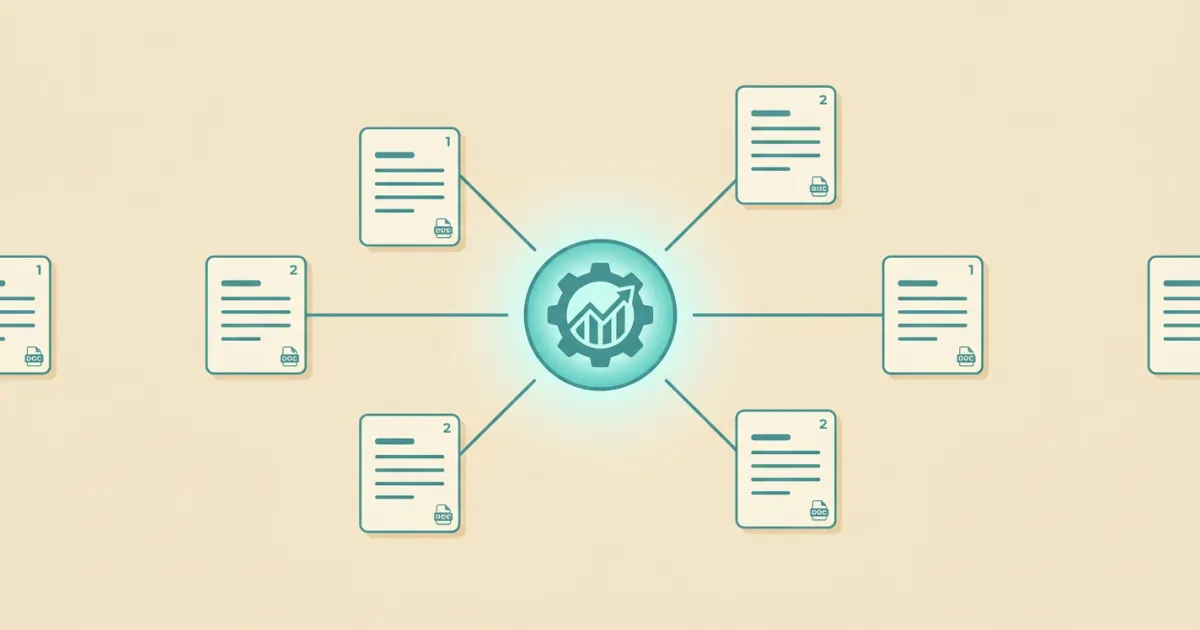
An AI knowledge base is a collection of your organization's documents, notes, and files that an AI layer makes answerable in plain language. Instead of browsing folders or guessing keywords, you ask a question and the system retrieves the most relevant passages and composes a direct answer, with citations to the original documents.
Three capabilities separate it from a traditional knowledge base:
• Semantic search: it matches on meaning using vector embeddings, not just exact keywords, so "how do I expense a flight" finds the travel-reimbursement policy even if those exact words never appear together. • Generated answers: it synthesizes one clear answer from multiple documents, rather than returning ten links to read. • Citations: answers link back to the source passage, so you can verify the answer instead of trusting it blindly.
Adoption is now mainstream. Stanford's 2025 AI Index reports that 78% of organizations used AI in 2024, up from 55% the year before.
How does an AI knowledge base work?
Most AI knowledge bases use a technique called retrieval-augmented generation (RAG). The pipeline has four steps:
• Ingest: your documents are split into small passages and converted into vector embeddings, which are numerical representations of meaning. • Retrieve: when you ask a question, the system embeds the question and finds the passages closest to it in meaning. • Generate: a large language model writes an answer using only those retrieved passages as its source. • Cite: the answer links back to the exact passages it used.
The key design choice is that the answer is grounded in your retrieved documents, not in the model's general training. That is what keeps it specific to your organization and verifiable.
Why use an AI knowledge base instead of a wiki or shared drive?
A wiki or shared drive stores information; it does not answer questions. Finding an answer still means knowing where to look, opening files, and reading. As the document count grows, the cost of finding the right passage grows with it.
An AI knowledge base inverts that. You ask; it finds and answers. The benefits compound for teams:
• Faster answers: no folder spelunking, just ask in plain language. • Consistency: everyone gets the same sourced answer, not a personal interpretation. • Onboarding: new hires can ask the knowledge base instead of interrupting colleagues. • Trust: citations let the reader confirm the answer against the original document.
What makes a good AI knowledge base?
Not all AI knowledge bases are equal. The qualities that matter most:
• Citations on every answer: without a link to the source, you cannot tell a correct answer from a confident guess. Grounded, cited answers are the difference between a tool you can rely on and one you have to double-check. • Access control: the knowledge base must respect who can see what, so a question never surfaces a document the asker should not read. • Privacy: your documents should not be used to train someone else's model. • Freshness: when a document changes, answers should reflect the new version.
Tatsulok is built on these principles. Every answer is cited to your documents, access is controlled per item, and your data stays private. If the annoyance is pasting the same background into every new chat, keep that context in the documents instead. Cited answers are how you check what comes back.
FAQ
- What is an AI knowledge base in simple terms?
- It is a place where your documents become answerable. Instead of searching folders and reading files, you ask a question in plain language and get a direct answer with links to the source documents it came from.
- What is the difference between an AI knowledge base and a wiki?
- A wiki stores pages you have to find and read. An AI knowledge base understands your question, retrieves the relevant passages across all your documents, and writes a single cited answer. One stores information; the other answers questions.
- How does an AI knowledge base avoid making things up?
- It uses retrieval-augmented generation: the AI answers only from passages it retrieves from your documents, and cites them. Because the answer is grounded in your real sources and linked back to them, you can verify every claim instead of trusting a guess.
- Is my data safe in an AI knowledge base?
- It depends on the tool. A trustworthy AI knowledge base keeps your documents private, does not use them to train external models, and enforces access control so each person only gets answers from documents they are allowed to see. Tatsulok is built this way.
- Do I need technical skills to build an AI knowledge base?
- No. Modern tools like Tatsulok let you upload documents and start asking questions immediately. The retrieval, embedding, and citation work happens automatically, with no setup or coding required.
Sources
Related guides
Knowledge base from documents
A step-by-step guide to turning a folder of documents into an AI knowledge base: gather, upload, ask, and verify. No tagging, schema, or code required.
Read the article
Give AI the right context
Each new chat starts blank, so you paste the same background again. Keep your documents in one place, ask once, and open the line the answer came from.
Read the article
Context rot
Context rot is the accuracy drop language models suffer as input grows, long before the window fills. At 32,000 tokens, 11 of 13 models scored under half.
Read the article