The entry fee that kept you out of business software
For thirty years, business software asked you to learn its system before it would help you. That entry fee, not the software's power, is what kept most one-person businesses outside. And the famous claim that 70 percent of digital transformations fail is not a real measurement.
Updated
Why is business software so hard to learn?
You once opened a spreadsheet on your phone. Rows and columns filled the small screen. A menu offered words like format, formula, filter. You closed it and went back to your notebook. The notebook works. It is just hard to search.
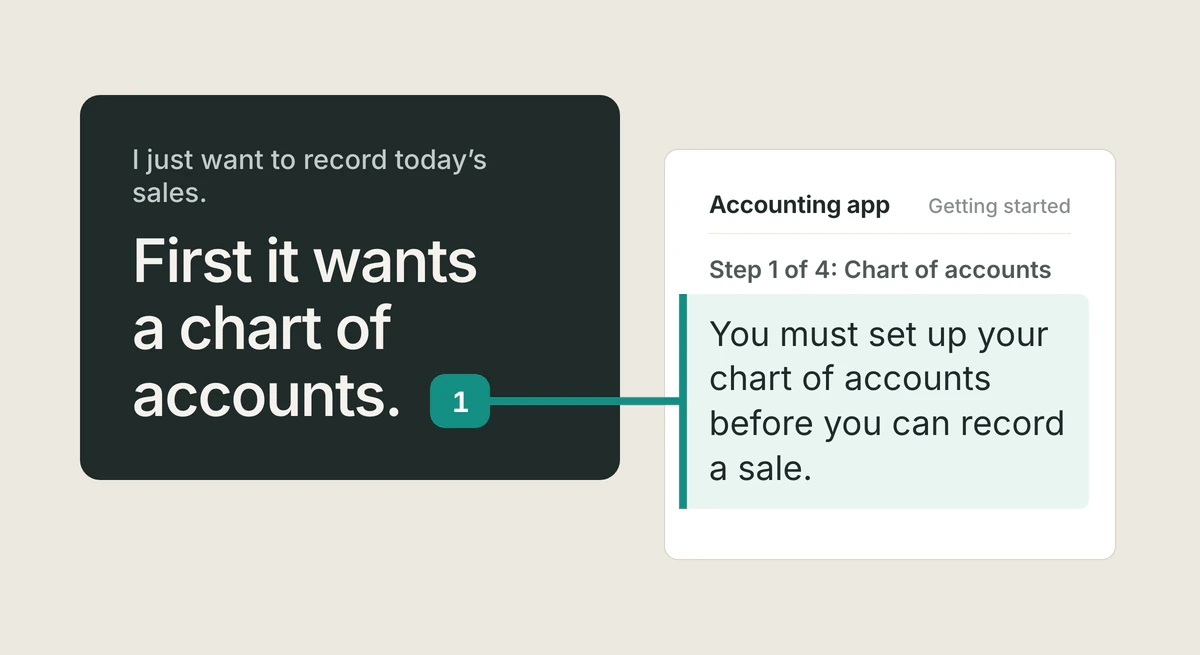
Nothing in that moment was a failure on your part. The app you opened was built for people whose job is the app. It assumed training, practice, and spare time. It asked you to learn its language before it would say anything useful back.
For about thirty years, business software has worked like a club with a cover charge. The software is inside, and it is powerful. But first you pay the entry fee: hours of learning menus, terms, and rules that have nothing to do with your sari-sari store, your eatery, your four rental units, or your print shop. Companies pay that fee with training days and hired staff. A one-person business has no training day and no one to learn it for you.
So most one-person owners did what any sensible person does at a door with too high a fee. They walked back to what works. Your notebook is not a lesser choice. It is a rational one. The software's power was real, but power behind a door that demands weeks of study is power you never get to use.
That is the quiet story of the last thirty years. Not that small owners were unwilling to learn, but that the price of admission was set by people who never had to run a store alone. Once you see that price clearly, you can stop blaming yourself for staying outside.
Is it true that 70 percent of digital transformations fail?
No. That number is not a real measurement, and it never was. If someone selling software, a seminar speaker, or a business article gave you the 70 percent figure, they were passing along an estimate that was never science.
The claim traces back to a 1993 book by Michael Hammer and James Champy. The authors themselves called their own figure an unscientific estimate. The book was about business process reengineering, a corporate idea from another decade, and it was written before anyone used the phrase digital transformation.
In 2011, Mark Hughes published a peer reviewed review that went looking for the evidence behind the sources most often cited for the 70 percent figure. He found none. No valid empirical evidence, anywhere, for a number that has been repeated for thirty years.
Here is what actual measurement looks like. McKinsey's own 2018 survey asked 1,793 respondents about their companies' digital projects, and 16 percent said their transformation both improved performance and sustained the improvement. A 2020 study by Boston Consulting Group covered 825 senior executives: 30 percent said their digital transformation met or exceeded its targets, 44 percent created some value but missed targets, and 26 percent created little or no value. That is a mixed picture, honestly counted, and it looks nothing like 70 percent failure.
Two things follow. First, the measured shortfall is not the same as failure: BCG's 44 percent that missed targets still created value, and lumping them in with the 26 percent that created none is exactly how the 70 percent story keeps regenerating. Second, these surveys describe large companies with consultants and training budgets, which means even well funded teams find the entry fee hard to pay. The story that small owners failed where big companies succeeded was never backed by evidence. It was a claim that sounded like data.
If the software is so powerful, why do so many projects fail?
When researchers list the causes of failed business software rollouts, the top three are poor user adoption at 43 percent, poor data quality at 34 percent, and insufficient training at 22 percent. Look at what is not on that list: the features. The power of the software is almost never the reason it fails. Getting through the door is.
All three top causes are forms of learning. Adoption means people choosing to use the thing. Data quality means someone entering and cleaning the records. Training means hours spent becoming fluent. This is the entry fee, itemized, and even companies with trainers, manuals, and payroll struggle to pay it.
Now place yourself beside that picture, not under it. You have no staff, no training day, no spare afternoon. You have a phone, a store to run, and children to fetch at four. If a company with a budget cannot always get its people fluent, an owner studying menus alone at night was never the audience that software was designed for. That is an observation about the software, not about you.
So the failures were never a verdict on small owners. They were the entry fee, collected at scale. A door that trained teams cannot walk through comfortably is not a door you should have been asked to open alone. Saying so is not making excuses. It is reading the numbers.
So is my notebook better than business software?
Your notebook was never the problem, and it is not the villain of this chapter. It works. It holds your sales, your utang, the dates you need to remember. It opens in one second, it never needs a password, and it speaks your own shorthand.
It has one gap, and it deserves to be named plainly. A notebook is hard to search. You cannot ask it a question and get an answer. When you need what you wrote in March, you flip pages until you find it, and some days you do not find it. That is the whole gap. Not primitive, not outdated, not a failure. Just hard to search.
Everything else, it does well. It is always with you. It survives a dead battery and a dropped phone. And it holds records you actually kept, every day, for years, which is more than many systems with corporate budgets can claim. A record you keep beats a system you abandon.
So this chapter does not ask you to defend your notebook or to feel bad about it. It asks something smaller and more useful: see the pattern clearly. For thirty years the door was priced wrong, and you chose the path that works. The honest next question is what a tool would look like if it met you at your notebook instead of demanding you come to its spreadsheet.
What can I do in the next five minutes?
Here is the drill. Five minutes. Paper or the notes app on your phone, whichever is closer. Nothing to install, nothing to sign up for.
Step one: set a timer for five minutes, so this stays small. Step two: write one sentence that begins with the words I keep my records by, and end it with the truth. Not the version that sounds organized. The real one.
Truthful endings look like this. I keep my records by a notebook under the cash box, plus hundreds of receipt photos in my camera roll. I keep my records by chat messages with my supplier and a folder of contracts in the cabinet. I keep my records by whatever notebook or phone was closest when the money moved. Every one of those is honest, and honest is the only standard.
Step three: add one sentence about the part that is hardest. The hardest part is finding what I wrote last March. The hardest part is totaling utang across three pages. The hardest part is matching a receipt photo to the right week. Pick yours.
That is the whole drill, and it is not a small thing. In five minutes you produced the one sentence no salesperson ever asked for: an honest description of how you keep your records today. Every system for thirty years started with its own menus and worked backward to your life. You just started with your life. That is the correct order, and you wrote it yourself.
FAQ
- Where did the 70 percent figure come from?
- From a 1993 book by Michael Hammer and James Champy, where the authors themselves described it as an unscientific estimate. It was about business process reengineering, not digital transformation, and it predates the term. A 2011 peer reviewed review by Mark Hughes found no valid empirical evidence for the figure.
- Was the person who quoted me the 70 percent number lying?
- Almost certainly not. The number has been repeated in meetings, seminars, and articles for so long that people pass it along in good faith. Now that you know where it started, you can pass the correction along too.
- My notebook works. Do I have to change anything?
- No. Nothing in this chapter asks you to stop using your notebook or to buy anything. The one honest gap is search, and naming that gap in a sentence is the whole assignment.
- What if I tried software before and gave up on it?
- You hit the entry fee, not a personal shortcoming. Poor adoption and insufficient training are the most common causes of failed rollouts, even inside big companies with paid trainers. Walking back to your notebook was the sensible call, and the notebook kept your records the whole time.
- What counts as keeping records?
- Everything that holds what you need to remember: the notebook, the receipt photos in your camera roll, the chat thread with your supplier, the folder of contracts. If you could point to where an answer lives, that is a record. The sentence you wrote names it.
Sources
Related guides
What digital transformation means
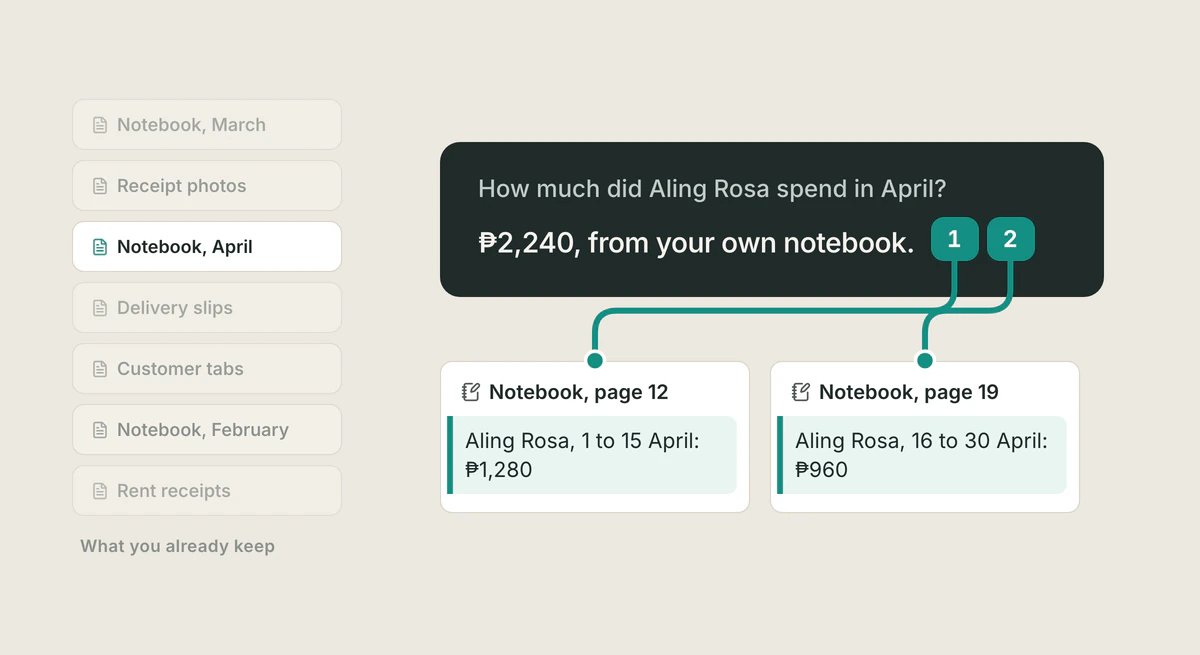
Digital transformation means turning what you already do into information you can look up, check, and decide from. No software needed to start.
Read the article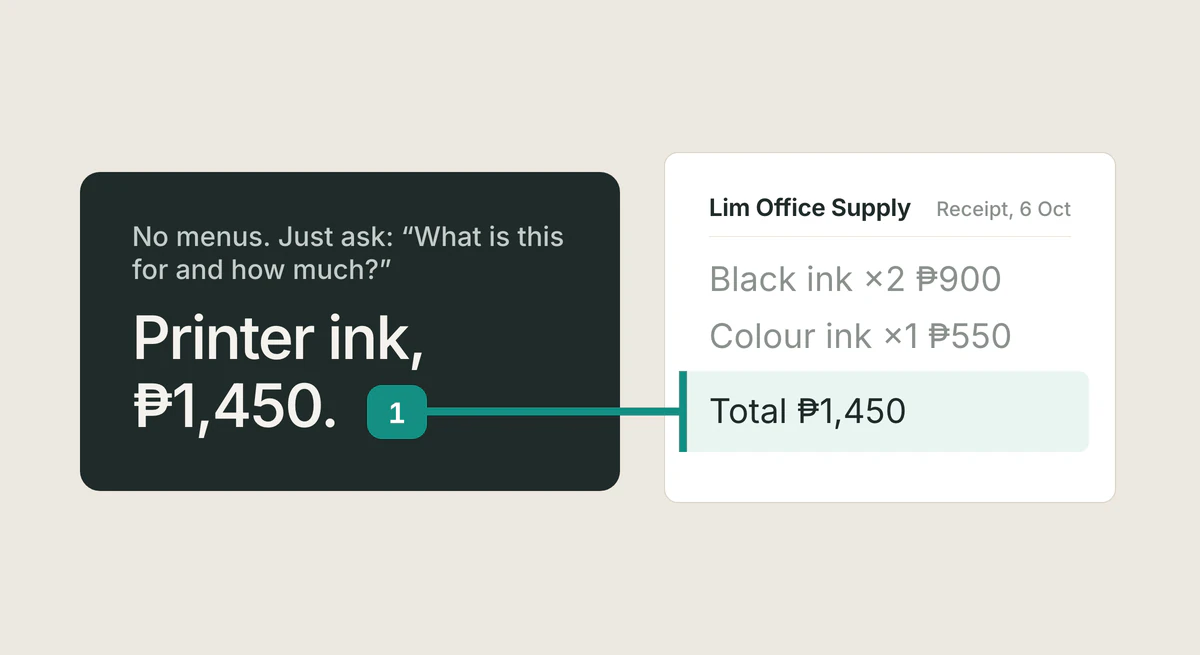
Plain language is the interface
Type what you want in ordinary words and the software does the rest. What changed, why beginners gain the most, and a ten minute drill with one receipt.
Read the article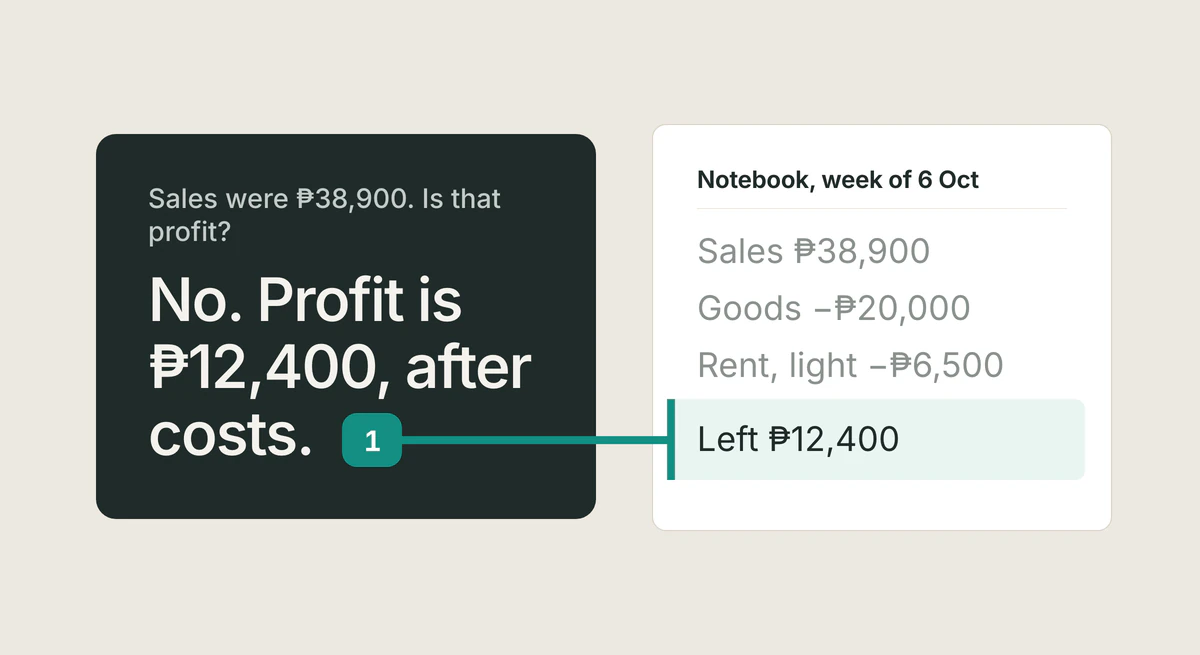
Is your business making money?
Sales are not profit, and money in the drawer is not either. One rule of thumb, worked through with real numbers, for owners who keep their records in a notebook.
Read the article