How to know if your business is actually making money
Your business is making money if what you sold, minus what the goods cost you, minus what you spent to keep the store open, is more than zero. Sales alone cannot tell you this, and the cash in the drawer cannot either, because some of that cash is not yours to keep. This guide works through one rule of thumb you can apply to a single page of your notebook today, in about ten minutes, without changing how you keep records.
Updated
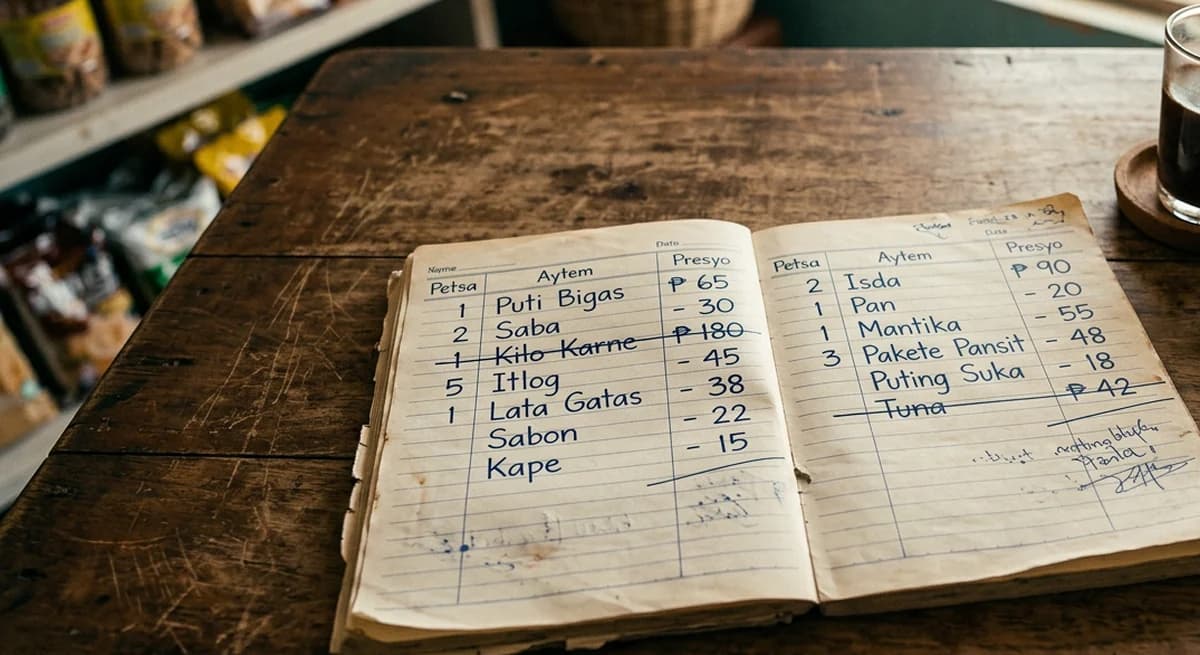
Why the money in the drawer is not the answer
Most owners judge the week by how the drawer feels. It is the most available signal and it is the one that misleads most often, for three reasons that all point the same way.
Some of that cash came from goods you have not replaced yet. When you sell a case of noodles, the money arrives today and the cost of buying the next case arrives next week. A drawer counted before you restock looks better than the business is.
Some of what you sold is not in the drawer at all, because it went out on utang. The goods left the shelf, the money did not arrive, and unless the notebook separates the two, a good week on paper can be a week where you funded your customers.
And some of that cash has already left for something else. Money taken out for groceries, for a school need, for a jeepney fare, is real spending, and if it is not written down then the drawer is short for a reason you can no longer name.
None of this is a bookkeeping failure. It is what happens when sales, credit, and household cash all move through the same drawer, which is the normal shape of a small business run by one person.
The one rule of thumb: three piles, one subtraction
Research on training micro-entrepreneurs found something useful here. When owners were taught standard accounting, their practices and revenues did not measurably improve. When they were taught a simple rule of thumb instead, both did, and the gain was largest for the owners who had the least formal training to begin with. The lesson is not that accounting is wrong. It is that a rule you can apply on a busy day beats a system you cannot.
So here is the rule. Take one page of your notebook, any ordinary day, and sort what is written on it into three piles.
The first pile is what came in and is yours. Cash sales. Money actually received, including a payment against an old utang.
The second pile is what came in but is not yours yet. Goods that left on utang. Write the total separately, because this is the number that turns a profitable-looking day into a loss.
The third pile is what went out. What you paid your supplier, plus anything spent to keep the store open that day, plus any cash you took for the household.
Then do one subtraction: the first pile minus the third pile. That is what the day actually earned you. The second pile is not income yet. It is a promise, and you find out later whether it was a good one.
A worked example, with the numbers on the page
Take an ordinary Tuesday at a small store.
The page shows ₱3,200 in sales. That is the number most owners would quote if asked how the day went.
Sorted into the three piles it looks different. Of that ₱3,200, ₱2,450 came in as cash and ₱750 went out on utang to four regular customers. A supplier delivery was paid in cash, ₱1,600. Load and a small repair came to ₱180. And ₱300 was taken out for rice and viand at home.
So the first pile is ₱2,450 and the third pile is ₱2,080. The day earned ₱370.
Not ₱3,200, and not the ₱1,900 or so that might have been left in the drawer. ₱370. Which is a real profit, on a real day, and worth knowing precisely because it is smaller than it felt.
Now notice what the ₱750 of utang does. If those four customers pay this week, the day was genuinely fine. If they do not, you paid ₱1,600 to a supplier for goods that are now sitting in someone else's kitchen. Same page, same handwriting, two completely different weeks, and the only thing that separates them is whether you tracked which pile each line belonged to.
What to do with the number once you have it
One day is a sample, not a verdict. A quiet Tuesday and a payday Friday are different businesses. So do this for four or five ordinary days across a couple of weeks, and look at the shape rather than any single figure.
Three things usually become visible, and each one has an action attached.
If the number is thin but positive, the question is pricing, and you now have the arithmetic to ask it properly rather than guessing. A ten-peso adjustment on your fastest-moving item is worth more than a new product line.
If household withdrawals are the biggest item in the third pile, that is the leak most worth naming. Nothing is wrong with paying yourself. What hurts is paying yourself without knowing you did, then wondering why the supplier money is short.
And if the utang pile keeps growing while the first pile stays flat, you are financing your customers out of your own working capital. That is a decision you may well choose to keep making, because those customers are your neighbours and they come back. It should just be a decision, made with the number in front of you, rather than something that happened to you.
Doing this without keeping a second set of books
Everything above works with the notebook you already keep. That is deliberate. Most of the free apps aimed at small stores ask you to type each sale into a phone, and the survey evidence is blunt about how that goes: owners install them and keep writing in the notebook, because typing at the counter is one more thing to do at exactly the moment there is no time.
So the practical version is small. Draw a line down your page and put utang on one side, cash on the other. Write household withdrawals on the page instead of remembering them. That is the whole change, and it makes the three-pile sort take minutes rather than an evening.
This is also the part Tatsulok is being built for. You photograph the page you already wrote, and it does the sorting and the subtraction, showing you which handwritten line each number came from so you can check it yourself. The notebook stays where it is. The arithmetic stops being your job.
One honest limit worth saying plainly: a notebook page records what you sold, and what your goods cost you often lives on a supplier receipt, which is a different piece of paper. Any tool claiming a precise margin from one photographed page is guessing at half of it. Ask what it read, and be suspicious of a total that cannot show you its own sources.
FAQ
- Is my sales total the same as profit?
- No. Sales tell you what left the shelf. Profit is what remains after the cost of those goods and the cost of keeping the store open. A day with high sales and a large supplier payment can earn less than a quiet day with none.
- Should I count utang as income?
- Not yet. Goods sold on credit are a promise of money, not money. Track the utang total separately and count it as income only when it is actually paid, otherwise a slow-collecting week looks profitable while your working capital drains.
- Do I need to register with the BIR before doing this?
- No. This is your own arithmetic about your own business, and it is useful whether or not you are registered. Registration and filing are separate questions with their own rules, and an accountant is the right authority on those.
- How often should I do the three-pile sort?
- Four or five ordinary days spread over two weeks gives you a shape you can trust. After that, once a week on one representative day is enough to notice when something changes.
- What if my notebook is messy or I miss days?
- That is normal and it does not disqualify you. Work with the pages you have. A number from five imperfect days beats no number, as long as you know which days you counted.
Sources
- Drexler, Fischer & Schoar, Keeping it Simple: Financial Literacy and Rules of Thumb (AEJ: Applied, 2014)
- McKenzie, Small business training to improve management practices in developing countries (Oxford Review of Economic Policy, 2021)
- Accounting knowledge, practices, and financial performance of sari-sari stores (DWIJMH)
Related guides

Plain language is the interface
Type what you want in ordinary words and the software does the rest. What changed, why beginners gain the most, and a ten minute drill with one receipt.
Read the article
What digital transformation means
Digital transformation means turning what you already do into information you can look up, check, and decide from. No software needed to start.
Read the article
The software entry fee
For thirty years, business software charged an entry fee: learn its system first. The 70 percent failure number is not real. It was never you.
Read the article