Can AI fact-check AI? Why the blind spots are shared
Using one AI to fact-check another is not independent verification, because the checker shares the failure modes of the thing it is checking. Researchers measured this directly: in the Self-Correction Bench study, models corrected an error presented as someone else's input, yet missed the identical error in their own output 64.5% of the time across the 14 open-source models tested. Other work found that asking models to critique their own reasoning can make results worse, not better. None of this makes a second model useless; it makes it a flag, not a confirmation. The only checker that shares no blind spots with the generator is you, at the source passage. This post explains why, and where a second AI genuinely helps.
Updated
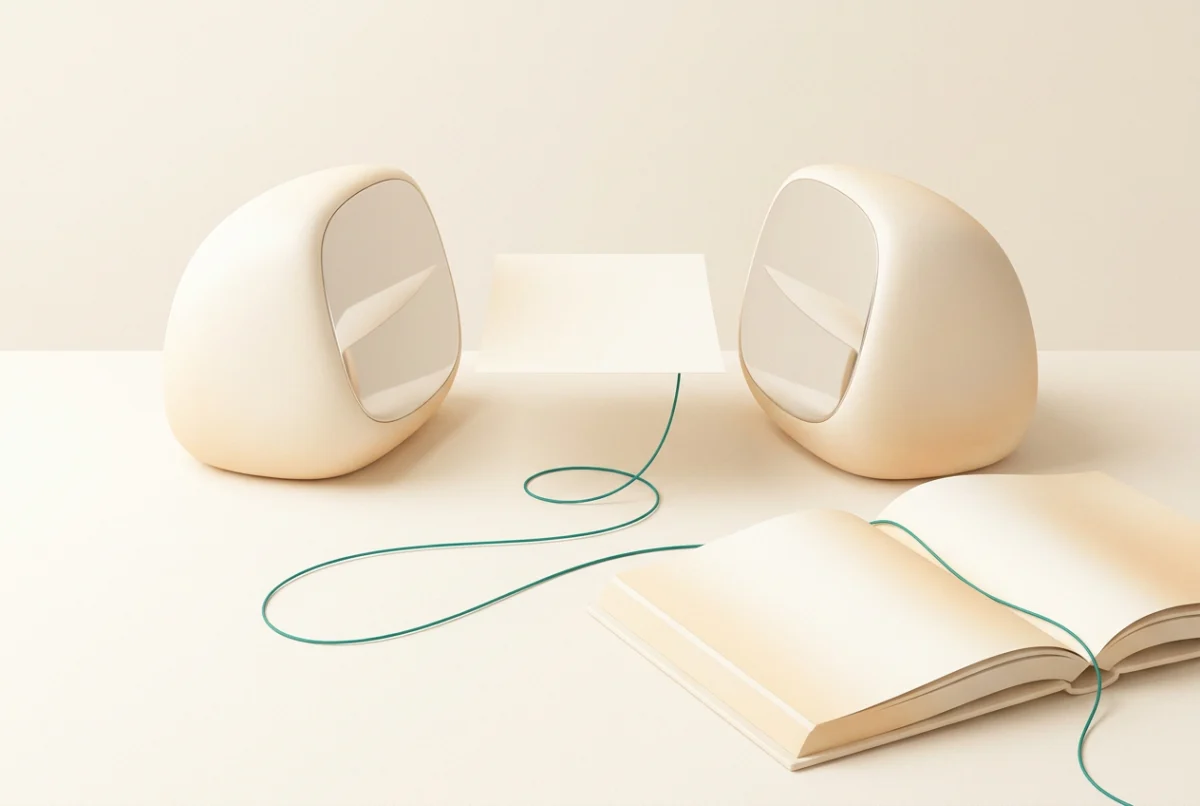
The comforting ritual that is not a check
It has become a common workflow: get an answer from one assistant, paste it into another, and ask, is this correct? The second model reads the fluent, confident text and replies with fluent, confident agreement. Two AIs have now signed off, and the answer feels double-checked.
What actually happened is that one system optimized to sound right reviewed the output of another system optimized to sound right. Neither opened a source. If the claim was plausible enough to be generated, it is usually plausible enough to pass, and plausibility was never the question. The ritual feels like verification because it copies the shape of one: a second opinion, a review step, a sign-off. It just skips the part where evidence gets consulted.
What the research measured
The Self-Correction Bench study made the comparison unusually clean. Researchers injected the exact same error into a conversation in two ways: once attributed to an external source, and once as part of the model's own earlier output. Models corrected the external version far more reliably; when the identical mistake appeared in their own words, they missed it 64.5% of the time on average across the 14 open-source, non-reasoning models tested.
A separate line of work on reasoning and planning tasks found something stronger: prompting models to critique and revise their own answers often degraded performance, with each round of self-critique compounding rather than correcting errors. And the deeper reason connects to what OpenAI's own researchers showed about why models hallucinate at all: training rewards confident answers over honest uncertainty. A checker built on the same incentive does not suddenly acquire the missing skepticism.
Why two AIs are not two witnesses
In court, in journalism, and in science, a second witness matters because their errors are independent. Two people who saw the event separately are unlikely to invent the same wrong detail. Independence is what makes agreement informative.
Two language models are not independent witnesses. They are trained on overlapping data, optimized by similar objectives, and rewarded by the same benchmarks for the same confident style. When a claim is the kind of thing models tend to get wrong, they tend to get it wrong together, and to affirm it in each other with equal fluency. This is also how source laundering compounds: the second model inherits the first model's confident restatement, now stripped of whatever weak sourcing produced it, and grades the polish instead of the provenance. Agreement between correlated systems is not two votes. It is one vote, counted twice.
What an independent check actually looks like
Independence means the verdict comes from something that did not produce the claim. In practice, that is the source itself: the document, the statute, the paper, the contract. A check is independent when you open the passage the claim rests on and read whether it says what the answer says it says.
That is deliberately the cheapest step in a grounded system. When every claim carries a link to its exact passage, the independent check takes seconds: read the claim, click, compare, decide. You do not need to check everything; you need the checks you do run to be real. Scope them to the claims that drive decisions, the numbers you will repeat, and anything that surprised you, the same triage the 90-second verification ritual teaches.
Where a second model genuinely helps
None of this means a second AI is worthless. It means knowing what it can and cannot tell you. Disagreement between two models is a useful flag: if they diverge on a factual claim, at least one is wrong, and you have found exactly where to open the source. A second model is also good at stress-testing an argument, surfacing counterpoints, and spotting internal inconsistencies, because those are properties of the text itself, not of the world. What a second model cannot do is confirm. Agreement is weak evidence; the passage is strong evidence.
Tatsulok is built so the strong evidence is always the near one: answers come only from your documents, every claim links to the exact passage behind it, and an honest gap is stated instead of papered over. The independent checker, you, gets a one-click path to the only opinion that settles it.
This week's drill, no signup needed: take one AI answer, ask a different AI to verify it, and then check one load-bearing claim yourself at the source. Score the AI verifier against the passage. Most people only need to run this once to recalibrate what agreement is worth.
FAQ
- Can I use one AI to fact-check another AI's answer?
- Not as a confirmation. Models share training data, objectives, and failure modes, so they tend to make and affirm the same mistakes. Research measured models missing errors in their own output 64.5% of the time even when they could correct the identical error presented as external input. Use a second model as a flag, not a verdict.
- What is the self-correction blind spot?
- The measured gap between a model's ability to correct an error attributed to someone else and its failure to correct the same error in its own output. The Self-Correction Bench study put it at 64.5% on average across the 14 open-source, non-reasoning models it tested.
- Why do two AIs often agree on the same wrong answer?
- Because their errors are correlated, not independent. Overlapping training data and the same reward for confident, fluent answers mean the claims one model gets wrong are often exactly the claims another model gets wrong, and affirms.
- Does asking an AI to double-check its own answer improve accuracy?
- Often not. Studies on reasoning and planning tasks found that self-critique prompting can degrade performance, with revisions compounding errors instead of catching them. Improvement generally requires external feedback, such as the source itself.
- What is the fastest genuinely independent check on an AI answer?
- Open the source passage the claim rests on and compare. In a grounded tool where every claim links to its exact passage, that check takes seconds, and it is independent because the source did not generate the answer.
Sources
- Self-Correction Bench: the self-correction blind spot in large language models (arXiv 2507.02778)
- On the self-verification limitations of large language models on reasoning and planning tasks (arXiv 2402.08115)
- OpenAI: Why language models hallucinate (September 2025)
- Tatsulok guide: why AI cannot stop hallucinating, according to the people who build it
- Tatsulok guide: source laundering, how weak sources come out of AI looking strong
Related guides
Verify AI answers
To verify an AI answer, demand a citation to the exact source passage and check the highlighted text against the original document. Here is how.
Read the article
AI hallucinations
AI hallucinations are confident but false AI answers. Learn why they happen, what they cost in the real world, and how cited answers help you catch them.
Read the article
AI mistakes at work
KPMG's global study found 57% of employees have made mistakes because of AI, and 58% rely on AI output without checking it. The two-habit fix that protects your work and your name.
Read the article