How to ask AI so it cannot hide the gaps
To make AI show its evidence, build five elements into the question: name the sources it may use, require a citation for every claim, explicitly permit "the sources do not say", set a date cutoff, and fix the output shape so gaps have nowhere to hide. A question built this way turns a smooth essay into a checkable list. This post teaches the pattern, with a template you can copy into any AI tool today.
Updated
The answer with no seams
You asked a fair question and got back a beautiful wall of prose. It flows, it sounds authoritative, and there is nothing to grab onto: no source named, no claim separated from the next, nowhere to start checking even if you wanted to.
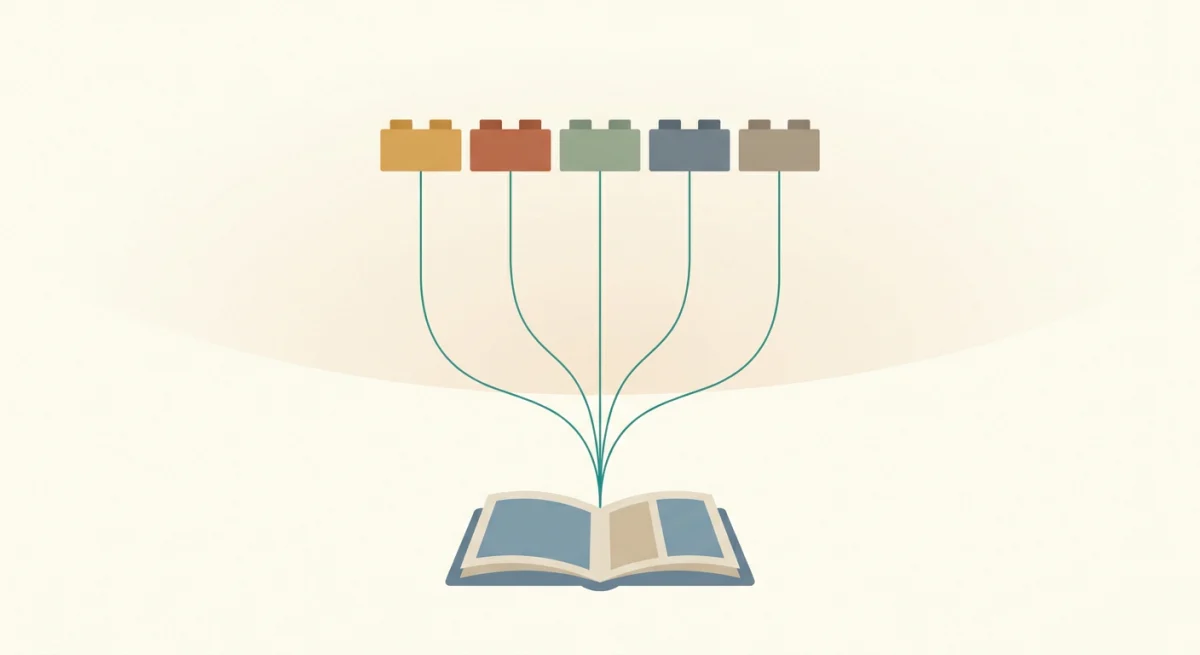
That wall is not an accident. An open-ended question invites the model to write the most plausible essay it can, and plausible essays hide their gaps in the mortar between sentences. The fix is not a smarter model. It is a question shaped so that every claim arrives as a separate, sourced, checkable brick.
Element one and two: scope the sources, demand a citation per claim
Start by naming what the AI may draw from: "answer only from the attached contract", "only from the 2025 policy manual", "only from the sources you can cite". Scoping does two jobs at once. It shrinks the space the model can improvise in, and it makes the next demand enforceable.
Then require the receipt: "support every claim with a citation to the specific section or passage." Per-claim is the important part. A bibliography at the end lets one real source launder ten unsupported sentences. One citation per claim means every sentence either has evidence attached or is visibly naked, and visibly naked is exactly what you want to see. Peer-reviewed testing found GPT-4 fabricating 18% of the references it generated freely, which is why the citation must point INTO your scoped sources, not out into the model's imagination.
Element three: give it permission to say the sources are silent
This is the element almost everyone skips, and it changes the whole game. Add one sentence: "if the sources do not contain the answer, say so explicitly instead of answering from general knowledge."
Without that permission, the model faces a forced choice between your question and the truth, and it is built to choose your question. With it, the honest gap becomes an allowed output, and you will be surprised how often it appears. Every "the sources do not address this" you receive is a fabrication that did not happen and a research gap you now know about.
Elements four and five: cutoff and shape
Set the time boundary: "as of this date", "using the version attached, not any later amendment." Stale answers are a quiet failure mode; a cutoff makes time explicit instead of assumed.
Then fix the shape: "answer as a numbered list, one claim per line, citation after each claim, open questions in a separate section at the end." Shape is what makes verification fast. A numbered list with per-line citations can be checked in the order it arrived; the open-questions section forces the model to put its uncertainty somewhere you can see it instead of smoothing it over.
The full template, ready to copy: "Using only [sources], as of [date], answer: [question]. Support every claim with a citation to the specific passage. If the sources do not contain the answer, say so explicitly. Format: numbered claims with citations, then a section for what the sources leave open."
What the prompt cannot do, and what to do about it
Honesty is now the invitation, but in a general chatbot it is still only an invitation. The model may comply beautifully today and drift tomorrow, and the citations it produces still need the 90-second check, because a request is not an enforcement mechanism.
Tools built around grounding turn these five elements from etiquette into architecture: Tatsulok scopes every answer to your documents and collections by design, attaches the passage link to every claim automatically, and treats "your sources do not contain this" as a first-class answer rather than a favor. The prompt pattern is still worth mastering, because it travels with you everywhere.
This week's drill, no signup needed: take a question you asked an AI recently and re-ask it with all five elements. Compare the two answers side by side. Count the claims you could check in the first, then in the second. The difference is what the pattern buys you.
FAQ
- How do I make AI cite its sources?
- Build five elements into the question: scope which sources it may use, require a citation for every claim (not a bibliography at the end), explicitly allow it to say the sources are silent, set a date cutoff, and fix the output as numbered claims with citations. Then verify the citations, because a request is not enforcement.
- Why does per-claim citation matter more than a source list?
- Because one real source at the end can launder many unsupported sentences. Per-claim citation makes each sentence either carry evidence or be visibly unsupported, which is what makes fast verification possible.
- Does telling AI to admit gaps actually work?
- It helps substantially in general chatbots, because it removes the forced choice between answering and being honest. But it remains a request. Grounded tools enforce the behavior architecturally, which is the reliable version.
- Will these prompts stop AI hallucinations completely?
- No. Testing found GPT-4 fabricating 18% of freely generated references, and prompting reduces exposure rather than eliminating it. The pattern shrinks the improvisation space and makes remaining errors visible and checkable, which is the realistic goal.
- Do I need these prompts in a citation-first tool?
- The scoping and citation elements come built in: tools like Tatsulok answer only from your sources and link every claim to its passage automatically. The habit of shaping precise questions still pays, because sharper questions retrieve better passages everywhere.
Sources
Related guides
Context rot
Context rot is the accuracy drop language models suffer as input grows, long before the window fills. At 32,000 tokens, 11 of 13 models scored under half.
Read the article
Why people don't fact-check
A 5,000-person survey caught the contradiction: people believe verification is the user's responsibility, and the largest single group says they do not want to check. What closes that gap is cost, not willpower.
Read the article
The AI literacy gap
In a 2026 Japanese AI literacy study, only 14.0% correctly described what generative AI does, while 45.3% picked the belief that it fully understands your intent unprompted. That belief is what makes checking feel unnecessary.
Read the article