Claude Projects or Tatsulok: which one fits the files you work from?
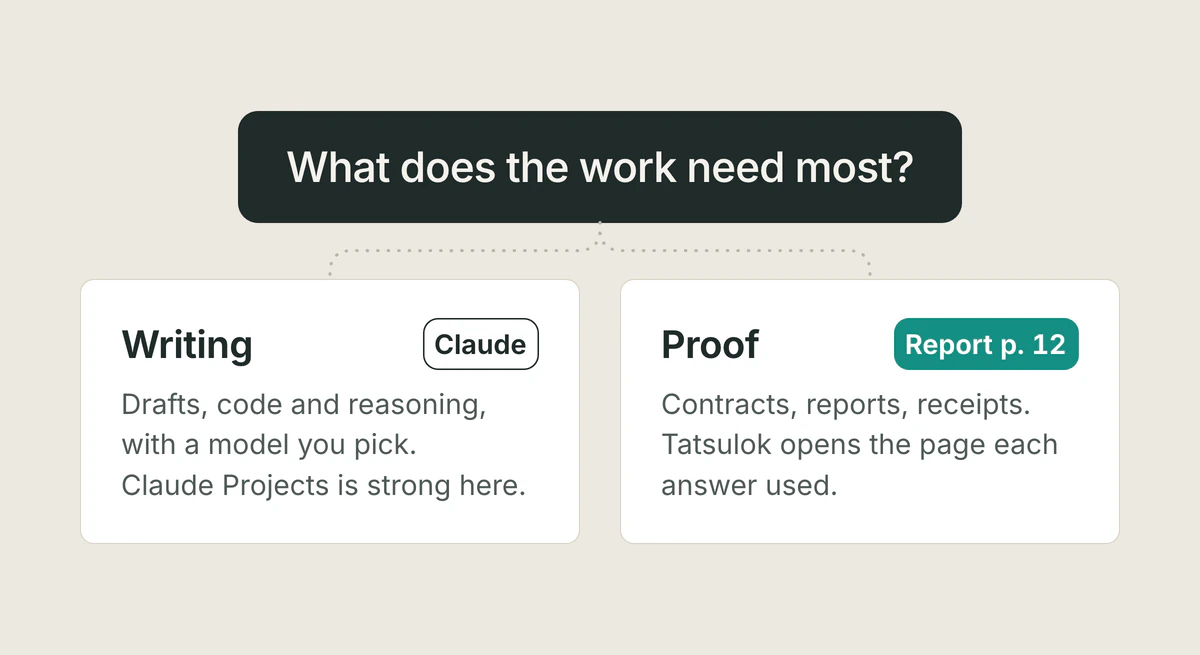
Pick Claude Projects if you want Anthropic's Claude to write, code and reason with your files at hand: you choose the model, it makes docs, decks and code, and its connectors reach Gmail, Google Calendar and Google Drive. Pick Tatsulok if you keep a growing library of your own documents and need to see the page an answer came from before you put your name on the work: each part of an answer cites the file, and the citation opens it at that page. You do not have to choose only one. Everything about Claude below was checked on Anthropic's own pages on 9 November 2026.
Updated
What is a Claude Project?
A project is a workspace inside Claude with its own chats, files and instructions. Anthropic's help page says projects let you "create self-contained workspaces with their own chat histories and knowledge bases". You add documents to the project knowledge, set project instructions (a formal tone, say, or a role to answer as), and every chat in the project starts from them. Each project also keeps its own memory. One chat does not see another chat in the same project; what they should share goes into the project knowledge.
Projects are on every plan, Free included, where you can create up to five. Anthropic is also rolling out a new version of projects in beta, starting with Claude Code: a project becomes one conversation that Claude splits into parallel threads running in the cloud, and you use it at claude.ai/code, in the desktop app or in the Claude mobile app. Some Pro, Max and Ultra users' projects have already moved to it; other chat projects stay on the current version for now. This page compares the current version.
How much can a Claude Project hold?
Each project file can be up to 30 MB, and there is no limit on the number of files, but Anthropic says the "total content must fit within Claude's context window", the amount of text Claude reads at once. It lists project files as "text extraction only (except for multimodal PDFs)", so the pictures inside a Word file are not read.
On paid plans (Pro, Max, Ultra, Team and Enterprise) that ceiling lifts. When project knowledge nears the context window, Claude switches on its own to a retrieval (RAG) mode that Anthropic says expands a project's capacity "by up to 10x". In that mode Claude searches the project for what each question needs instead of reading everything, and you see it use a project knowledge search tool. Anthropic suggests clear file names, and naming a document in your question, to help it find the right one. Free projects do not get this mode.
What does Claude cost, and what does each plan add to Projects?
Free is $0, with up to five projects and no retrieval mode. Pro is $20 a month, or $17 a month billed yearly ($200 up front), and adds the retrieval mode and the Opus models. Max is $100 a month with five times Pro's usage, and Ultra is $200 a month with ten times Pro's weekly usage. Team is for 2 to 150 people at $25 a seat a month, or $20 billed yearly, with Premium seats at $125, or $100 yearly. Enterprise is $20 a seat a month billed yearly, with a 20-seat minimum, plus usage at API rates. Prices exclude tax.
Every plan has usage limits. Anthropic says "How fast you reach a limit depends on the model you use, how long your chats are, and how large your files are", so a project full of long files uses your allowance faster.
Can your team share a Claude Project?
Only on Team and Enterprise. Anthropic's pricing page lists project sharing as not included on Free, Pro, Max and Ultra. On Team and Enterprise you share a project with named people, paste a list of email addresses, or open it to the whole organization. Each member gets "Can view" (see the knowledge and instructions, and chat in the project) or "Can edit" (change the instructions and knowledge, and manage members). Project sharing can also be turned off for the whole organization.
Tatsulok shares through its Teams plan: a shared library with roles, where one person uploads and organizes and the whole team can ask. The Family plan gives five people a shared library and a private one each.
Does Claude show which file an answer came from?
Anthropic's help pages on projects do not say how an answer points back to a file in project knowledge. They do say it for connectors: an answer that uses Gmail, Calendar or Drive "includes citations indicating which emails, calendar events, or documents were used as sources, with links to the originals when available." So when a figure from a project file matters, find it in the file before you use it.
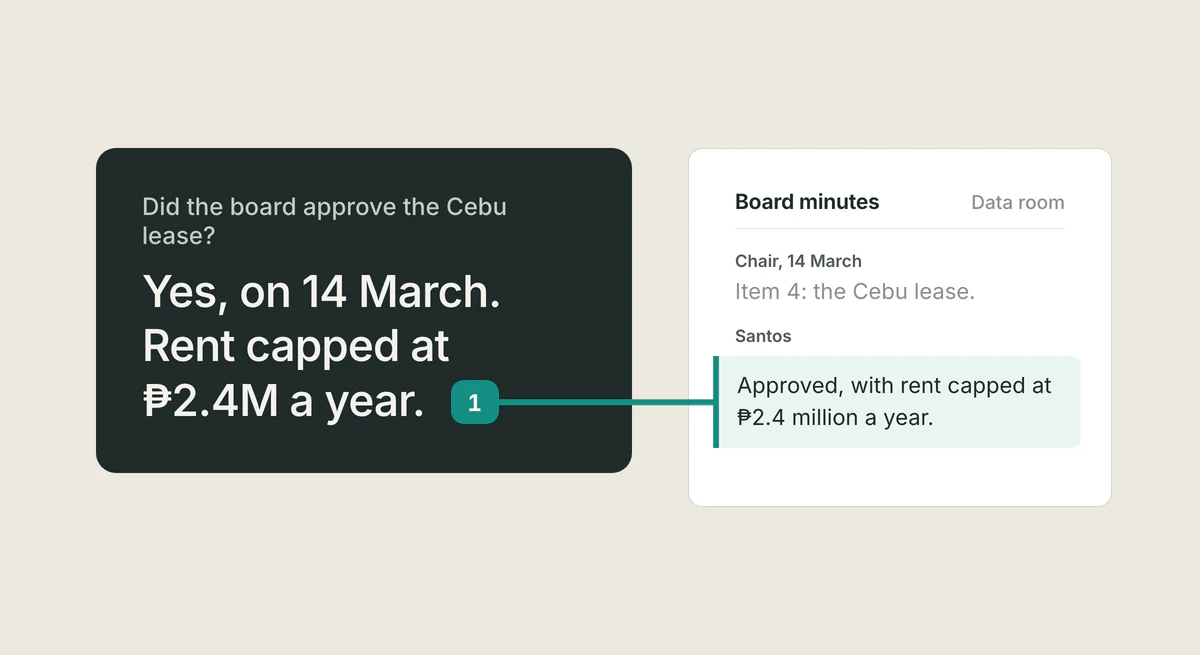
This is where Tatsulok is built differently. Each part of an answer about your files carries a citation. Open it and the file opens at the cited page, with the passage highlighted when Tatsulok finds the words on that page; when it cannot mark them, it says so in one line instead of guessing. You read the line, then decide.
Can Claude Projects read your Google Drive?
Yes, in private projects. You can add Google Docs from Drive to a project's files, and Anthropic says they "sync directly from Google Drive, so you're always working with the latest version." The Drive option is off in shared projects, and Claude reads a Drive file's text, not the images in it. Outside projects, the Google Workspace connectors (Gmail, Google Calendar and Google Drive) are open to every Claude user: Claude can search and draft mail, manage your calendar, and edit Google Docs, Sheets and Slides live beside the chat. Anthropic says it does not train its models on Gmail, Drive or Calendar connector data, with one exception: if you opted in to training, connector content you copy into a chat, or replies that include it, may be used to improve its models.
Tatsulok connects Google Drive and OneDrive in Beta: you ask about the files there, or copy them into your library. See connect your Drive.
Is your work used to train the model?
On Claude's Free, Pro, Max and Ultra plans, a setting called Help improve our AI models decides whether your chats and coding sessions train future models; Anthropic's pricing page lists model training on those plans as opt-out. You switch it off under Settings, then Privacy, on the web or in the app. Even then, Anthropic says conversations its safety classifiers flag may still be used for its trust and safety work, and what you send through the thumbs up or down buttons may be used too. On Team and Enterprise, Anthropic does not train on your content by default.
Tatsulok never sends your workspace to training datasets, and the model providers that answer your chat requests commit to no training and to keeping none of your content after each request. Voice input, web search, document extraction and search reranking run under their own providers' terms, named on the Trust & Security page.
Where does Claude win?
In a lot of places, and it is worth saying plainly.
• You choose the model: Sonnet and Haiku on Free, Opus from Pro up, and Fable on Max, Ultra, Team premium seats and Enterprise (through usage credits on Pro). In Tatsulok, Tatsu picks the model and you cannot choose one. • Claude makes things. Claude Docs, Slides and Design, on every plan, turn a conversation into a document, deck or design you can edit, share and export to formats such as PowerPoint and PDF. Pro adds Claude Code for software work. • Its connectors go wide. On Google Workspace, Claude reads and drafts mail, sends it with your approval, manages your calendar and edits Google files live. • Each project keeps its own instructions and memory, so Claude works the way that project needs. • Claude runs on the web, in a desktop app and in apps for iOS and Android.
If most of your work is writing, coding or thinking a problem through with a strong model, and your files fit in a project, Claude Projects is a good home for it.
When is Tatsulok the better fit?
When the work rests on your own documents and your name goes on the result: contracts, reports, receipts, case notes, a reply a client will read.
• Your library stays and grows, in folders and projects, with no cap on projects on any plan. Its limit is storage (1 GB on Free, 5 GB on Pro), not one context window; Tatsu searches the library for what each question needs. • Each part of an answer opens its source at the cited page, so checking takes a glance. • Free is useful on its own: 200 Tatsu credits a month and no card. A short answer is usually 1 to 3 credits. If you run out, credit packs start at $5 for 1,000, and a Free account can buy them. Pro is $15 a month, or $12 a month billed yearly, with 3,000 credits and 5 GB. See pricing. • You can export your data on every plan. Tatsulok runs in your browser, with apps on Google Play and the App Store.
What Tatsulok does not do: you cannot pick the model, it has nothing like Claude Code or Claude Design, and its Drive and Gmail connections are still in Beta. If you came from NotebookLM, see how Tatsulok compares with NotebookLM.
FAQ
- What is the best Claude Projects alternative?
- It depends on the work. For answers you can check against your own documents, in a library that keeps growing, Tatsulok fits: each part of an answer opens the file at the cited page. For writing, code and reasoning with a model you choose, Claude Projects is hard to beat, and you can keep both.
- Is Claude Projects free?
- Yes, with limits. A Free Claude account can create up to five projects, and their knowledge must fit in Claude's context window. The retrieval mode that lets a project hold up to 10 times more needs a paid plan, from Pro at $20 a month, or $17 a month billed yearly (checked 9 November 2026).
- How many files can a Claude Project hold?
- Anthropic sets no file count. Each project file can be up to 30 MB, and together they must fit in Claude's context window; on paid plans, the retrieval mode raises that by up to 10 times.
- Does Claude cite the files in a project?
- Anthropic's help pages on projects do not describe citations to project files. Its Google Workspace connectors do cite the emails, events and documents an answer used, with links to the originals when available. In Tatsulok, each part of an answer about your files opens the file at the cited page.
- Can I share a Claude Project with my team?
- Only on Team and Enterprise plans, where each member gets Can view or Can edit, or the whole organization can see the project. Free, Pro, Max and Ultra do not include project sharing. Tatsulok shares through a team library with roles on its Teams plan.
Sources
- Claude Help Center: What are projects? (checked 9 November 2026)
- Claude Help Center: How can I create and manage projects?
- Claude Help Center: Retrieval augmented generation (RAG) for projects
- Claude Help Center: Upload files to Claude
- Claude: Plans and pricing (checked 9 November 2026)
- Claude Help Center: Use Google Workspace connectors
- Claude Privacy Center: How do I change my model improvement privacy settings?
- Claude Privacy Center: How do you use personal data in model training?
- Claude: Artifacts (Claude Docs, Slides and Design)
- Claude Code Docs: Projects, the new version in beta
- Claude Help Center: What interfaces can I use to access Claude?
- Tatsulok: Pricing (checked 9 November 2026)
Related guides
Hebbia alternative
Looking for a Hebbia alternative? Tatsulok gives cited, verifiable answers from your documents with team sharing, without enterprise per-seat pricing.
Read the article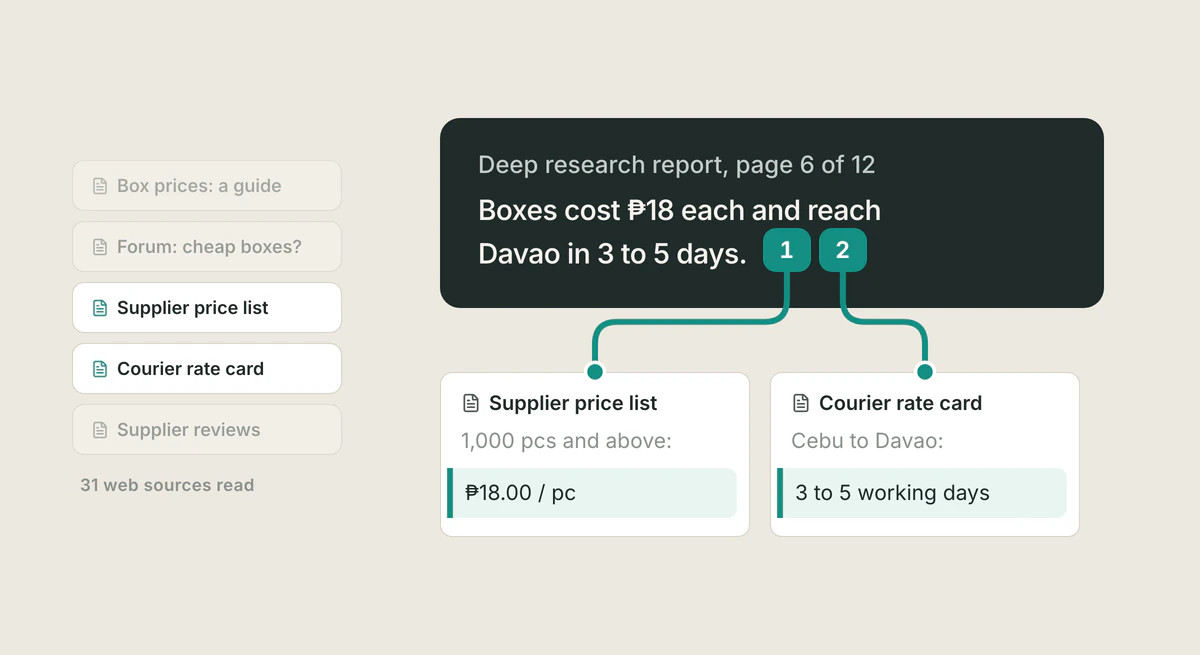
Deep research tools
ChatGPT, Perplexity, and Gemini deep research agents write long cited reports in minutes. What they do well, how they differ, and the verification step every one of them hands back to you.
Read the article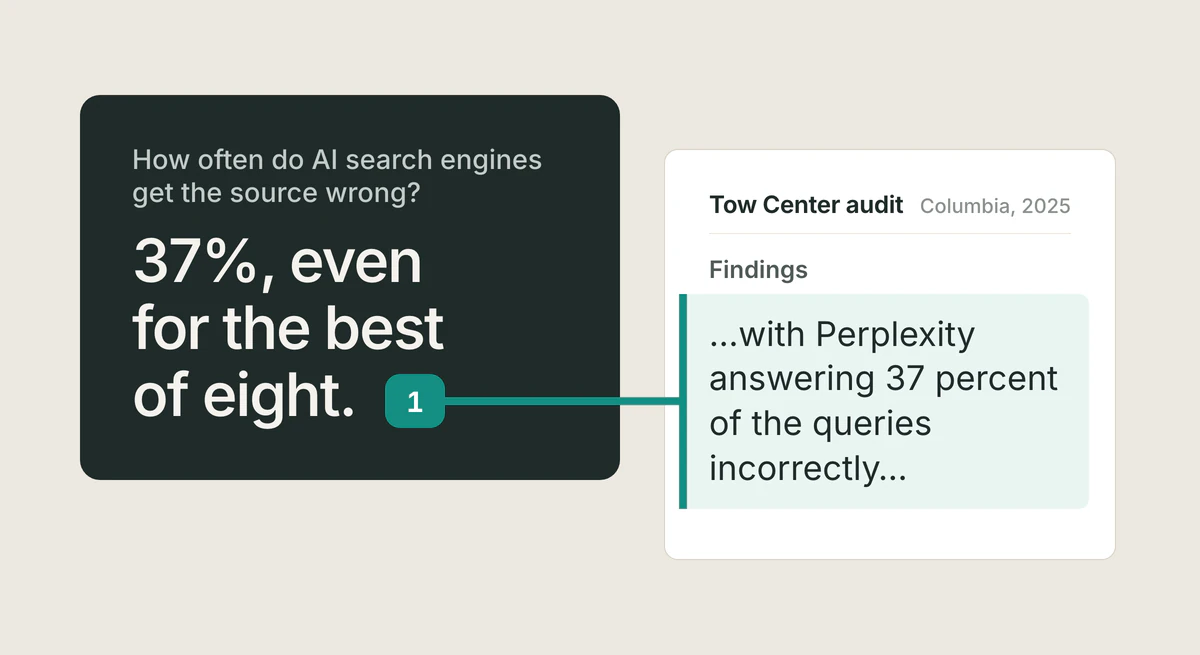
Best AI research assistants
We ranked the best AI research assistants of 2026 by one criterion: can you verify the answer? Citation audits, hallucination rates, and which tool fits which job.
Read the article