Illegal Dismissal in the Philippines: What the Labor Code Actually Says
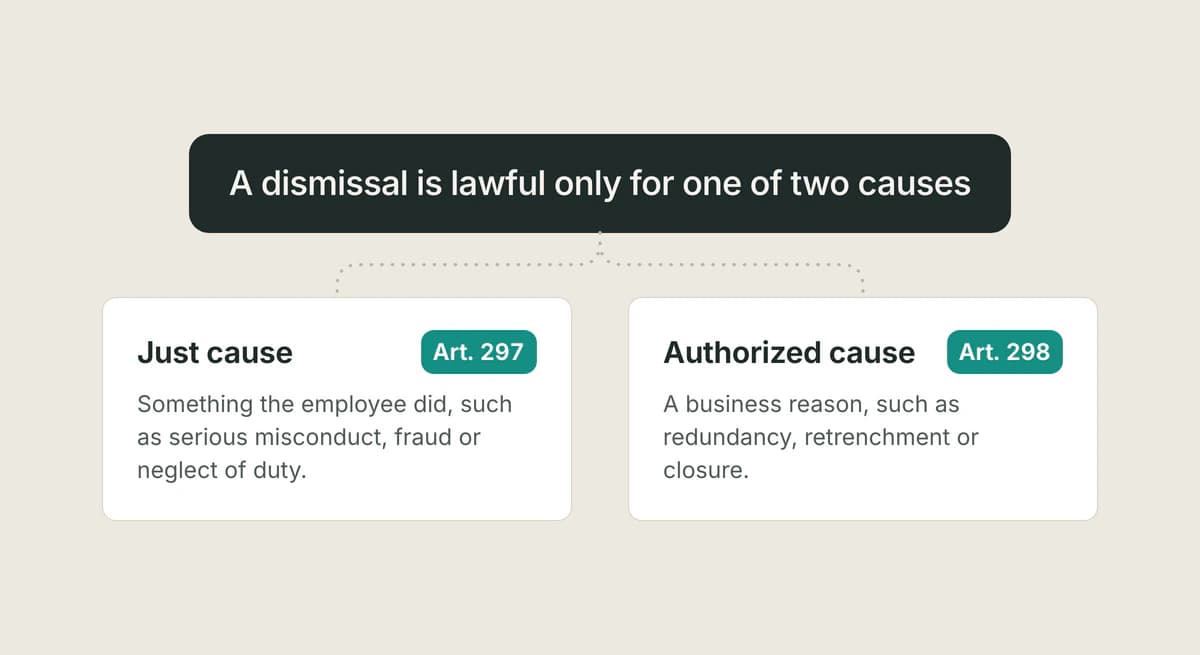
A dismissal in the Philippines is lawful only for a just cause, meaning something the employee did, or an authorized cause, meaning a business reason such as redundancy or closure. Anything else is illegal. Your employer must also give you written notice and a real chance to answer before dismissing you for a just cause. The single most important rule is one many people never learn: the Labor Code puts the burden of proving the dismissal was valid on the employer, not on you.
Updated
What makes a dismissal illegal?
Article 279 of the Labor Code states the rule plainly. In regular employment, "the employer shall not terminate the services of an employee except for a just cause or when authorized by this Title."
That gives you two lawful categories and nothing else. A just cause is about the employee's own conduct or performance. An authorized cause is about the business, such as redundancy or closure. A dismissal that fits neither is illegal, and so is a dismissal that fits one on paper but skips the required procedure.
One more provision shapes every dispute. Article 4 directs that "all doubts in the implementation and interpretation of the provisions of this Code, including its implementing rules and regulations, shall be resolved in favor of labor." Where the facts are genuinely unclear, the Code tells the reader which way to lean.
What counts as a just cause?
Article 282 lists five, and the list is closed apart from its own catch-all:
1. Serious misconduct, or willful disobedience of the lawful orders of the employer in connection with the work. 2. Gross and habitual neglect of duties. 3. Fraud, or willful breach of the trust reposed in the employee by the employer. 4. Commission of a crime or offense against the employer, an immediate member of the employer's family, or an authorized representative. 5. Other causes analogous to the foregoing.
Read the qualifiers, because they carry most of the weight. Misconduct must be serious. Disobedience must be willful, and the order must have been lawful and work related. Neglect must be both gross and habitual, so a single mistake does not qualify. Breach of trust must be willful. Poor performance, a personality clash, or one bad month is not on this list.
What counts as an authorized cause, and what separation pay applies?
Article 283 covers dismissals driven by the business rather than by you: installation of labor-saving devices, redundancy, retrenchment to prevent losses, and closing or cessation of operations. It expressly excludes closure done "for the purpose of circumventing the provisions of this Title."
Two requirements attach. First, the employer must serve written notice on both the affected workers and the labour department at least one month before the intended date. Second, separation pay is owed, and the amount depends on the ground:
For labor-saving devices or redundancy, at least one month pay, or one month pay for every year of service, whichever is higher.
For retrenchment to prevent losses, or closure not due to serious business losses, one month pay, or at least one-half month pay for every year of service, whichever is higher.
In both formulas a fraction of at least six months counts as one whole year. Article 284 treats disease as a separate ground, with separation pay of at least one month salary, or one-half month salary for every year of service, whichever is greater.
A note on the statutory wording: Article 283 still says notice goes to the "Ministry of Labor and Employment," the name in use when the Code was issued in 1974. The agency is now the Department of Labor and Employment.
Who has to prove the dismissal was valid?
Your employer does. The Labor Code states it in one sentence: "The burden of proving that the termination was for a valid or authorized cause shall rest on the employer."
This is worth pausing on, because the instinct after losing a job is to assume you must assemble a case proving you did nothing wrong. That is not how the Code allocates the work. The employer has to establish the cause and show the procedure was followed. If the employer cannot, the dismissal fails.
The practical consequence is about evidence. Keep every document you already have: your contract, payslips, any memo or notice you received, and any written exchange about the dismissal. You are not building a case from nothing. You are preserving the record against which your employer's account will be tested.
What notices is your employer required to give?
For a just-cause dismissal the Code requires the employer to "furnish the worker whose employment is sought to be terminated a written notice containing a statement of the causes for termination" and to "afford the latter ample opportunity to be heard and to defend himself with the assistance of his representative if he so desires."
Three things follow. The notice must be written, not spoken. It must state the causes, so "we are letting you go" is not compliant. And you must get a genuine opportunity to answer, with a representative if you want one.
This procedural requirement is separate from the substantive one. An employer can have a real just cause and still dismiss you unlawfully by skipping the notice and hearing. The Code also confirms that whatever the employer decides is "without prejudice to the right of the worker to contest the validity or legality of his dismissal by filing a complaint with the regional branch of the National Labor Relations Commission."
Does your contract decide whether you are a regular employee?
Largely, no, and this surprises people whose contracts label them contractual or project based.
Article 280 is written to defeat exactly that labelling. "The provisions of written agreement to the contrary notwithstanding and regardless of the oral agreement of the parties, an employment shall be deemed to be regular where the employee has been engaged to perform activities which are usually necessary or desirable in the usual business or trade of the employer."
The test is the nature of the work, not the title on the paper. If what you do is necessary or desirable to the employer's usual business, the Code leans toward regular employment regardless of what you signed. The same article carves out work fixed to a specific project whose completion was determined at engagement.
Article 280 also provides that an employee allowed to work after a probationary period is considered a regular employee. And under Article 286, a bona fide suspension of operations not exceeding six months is not a termination, which is the provision behind so-called floating status.
Why does the same provision have two article numbers?
If you research this yourself you will hit a genuinely confusing problem. One source cites just causes as Article 282, another cites Article 297. Both can be correct.
The Labor Code was renumbered, so many provisions now carry a second, higher article number, and sources differ on which they use depending on their vintage. The mapping for the provisions in this guide:
Security of tenure and backwages: Article 279, commonly cited as 294. Regular employment: Article 280, commonly cited as 295. Just causes: Article 282, commonly cited as 297. Authorized causes and separation pay: Article 283, commonly cited as 298. Disease: Article 284, commonly cited as 299. Money claims prescription: Article 291, commonly cited as 306.
This guide uses the original numbering of Presidential Decree 442 and gives the modern number alongside it. When you cite a provision, name the article and quote the language you are relying on. The quoted text is unambiguous even when the numbering is not.
What are you entitled to if the dismissal was illegal?
Article 279 sets the remedy. An employee unjustly dismissed "shall be entitled to reinstatement without loss of seniority rights and other privileges and to his full backwages, inclusive of allowances, and to his other benefits or their monetary equivalent computed from the time his compensation was withheld from him up to the time of his actual reinstatement."
Read the clock in that sentence. Backwages run from the day your pay stopped to the day you are actually reinstated, not to the day a case is filed or decided.
Complaints go to the regional branch of the National Labor Relations Commission, which the Code names directly. On timing, Article 291 gives three years for money claims, running from when the cause of action accrued, after which they are "forever barred." The deadline for contesting the dismissal itself is governed differently, so treat this as a reason to move promptly and to confirm the applicable period rather than as a single date to rely on.
One closing caution. This guide explains what the Labor Code says. It is not legal advice about your situation, and outcomes turn on facts and on Supreme Court decisions interpreting these articles. Use it to understand the framework, to know which provision governs, and to ask a labour lawyer sharper questions.
FAQ
- Is it illegal to be dismissed without notice in the Philippines?
- For a just-cause dismissal, yes. The Labor Code requires a written notice stating the causes and an ample opportunity to be heard and defend yourself. An employer who has a valid cause but skips the notice and hearing has still not complied with the Code.
- Who must prove that a dismissal was valid?
- The employer. The Labor Code states that the burden of proving the termination was for a valid or authorized cause rests on the employer. You do not carry the burden of proving your innocence, though you should preserve your contract, payslips, and any notices you received.
- How much separation pay applies for redundancy or retrenchment?
- For labor-saving devices or redundancy, at least one month pay, or one month pay per year of service, whichever is higher. For retrenchment to prevent losses, or closure not due to serious business losses, one month pay, or at least one-half month pay per year of service, whichever is higher. A fraction of at least six months counts as a whole year.
- Can an employer dismiss an employee for being sick?
- Only under the narrow ground in Article 284, which requires a disease whose continued employment is prohibited by law or is prejudicial to the employee's health or that of co-workers, and it requires separation pay of at least one month salary, or one-half month salary per year of service, whichever is greater. Illness is not a general licence to dismiss.
- Should I cite Article 282 or Article 297 for just causes?
- They refer to the same provision. The Labor Code was renumbered, so just causes appear as Article 282 in the original text and as Article 297 in many modern sources. Cite the article number your source uses and quote the language you rely on, so the reader can match it either way.
Sources
Related guides
Verify PH legal AI answers
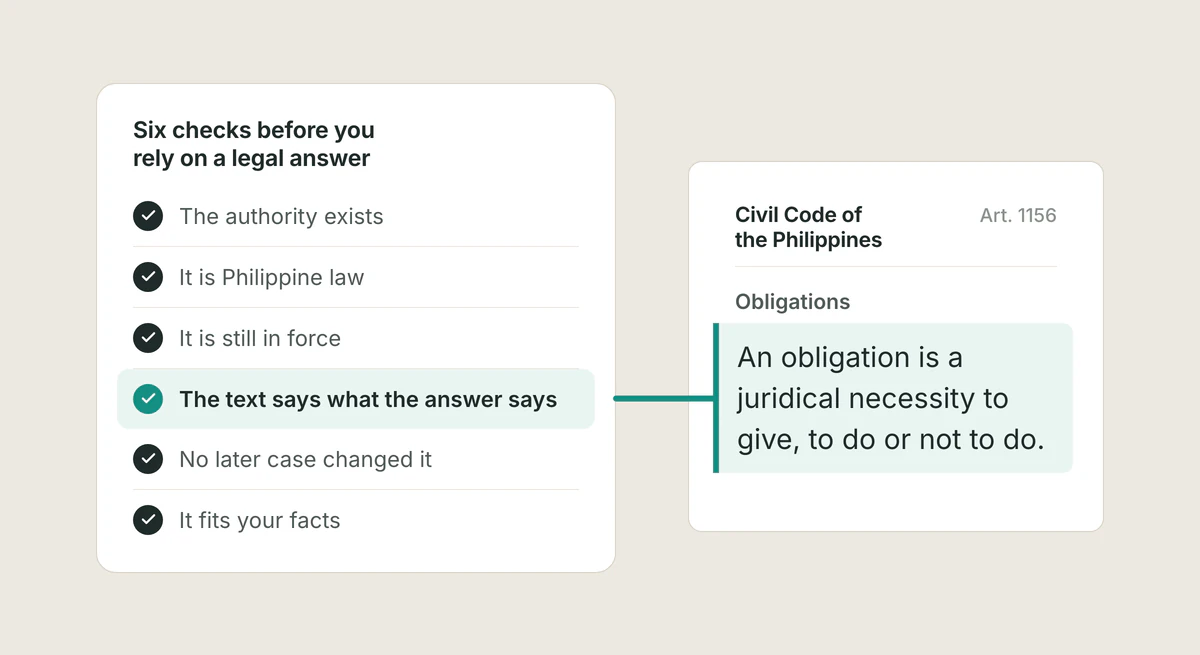
The six-point check for any AI claim about Philippine law: existence, jurisdiction, currency, the actual text, later treatment, and factual fit. With the free sources to check against.
Read the article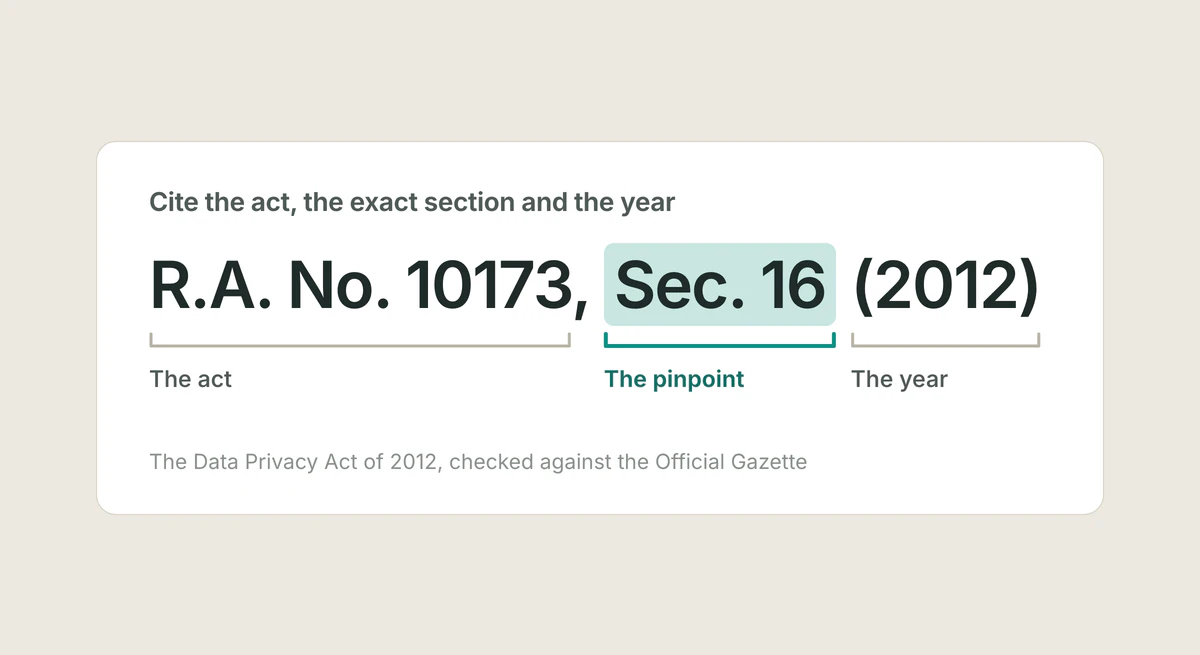
Legal Citation
To cite Philippine statutes, cases, the Constitution, and rules, give exact identifiers, dates, and pinpoints, then verify each against an official source.
Read the article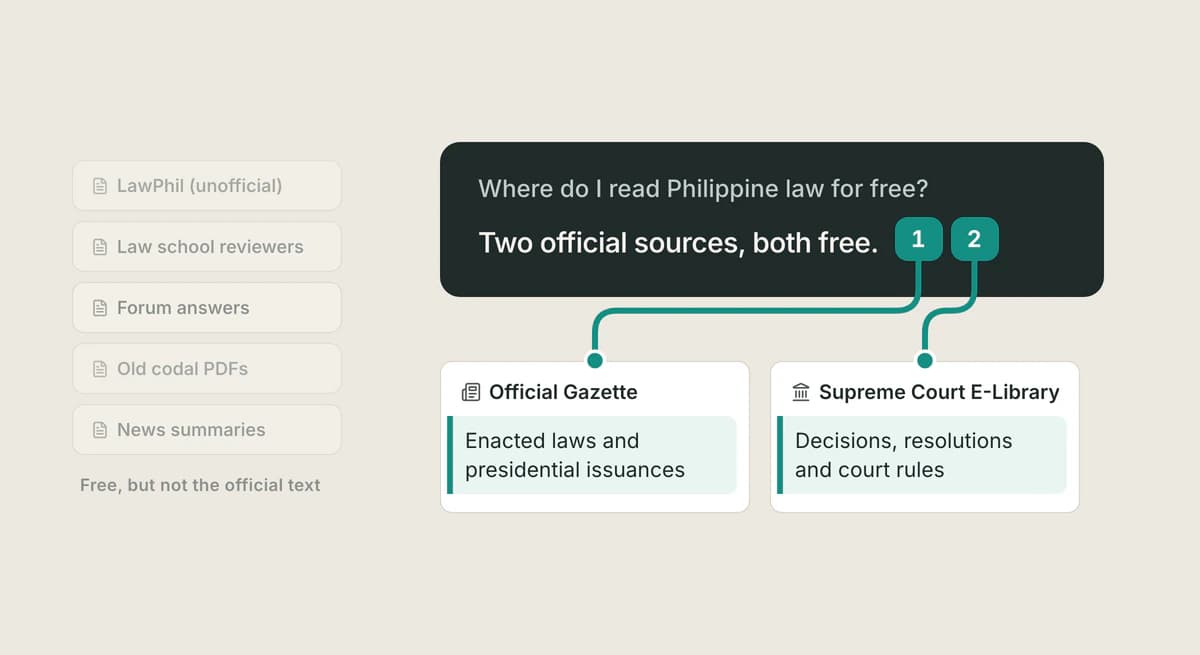
Free Legal Resources
Find free Philippine legal research sources for laws, cases, court rules, bills, and agency issuances, with clear guidance on authority and verification.
Read the article