ChatGPT fake citations: what courts are doing about them, and how not to be next
ChatGPT and other chatbots invent legal citations because they generate plausible text, not verified facts, and courts have stopped treating that as an excuse. Since Mata v. Avianca drew a $5,000 sanction in 2023 for six fabricated cases, judges have fined lawyers and firms tens of thousands of dollars for unverified AI citations, and an independent legal database now tracks hundreds of such filings worldwide. The fix is not to avoid AI. It is to never rely on a citation you have not opened, and to prefer tools that link every claim to the source itself.
Updated
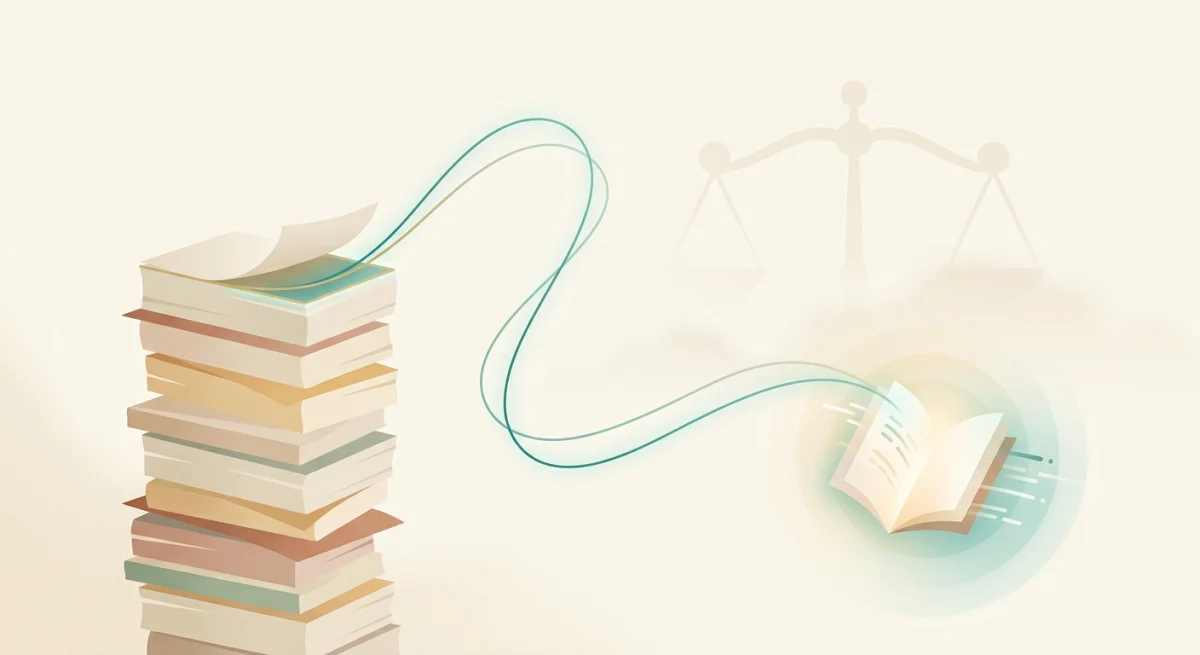
Why does ChatGPT invent cases that do not exist?
A language model is a text predictor. Asked for authority that supports your position, it produces something shaped exactly like authority: a plausible case name, a realistic docket number, a quotation in flawless judicial prose. Peer-reviewed testing published in Scientific Reports found GPT-3.5 fabricated 55% of the academic references it generated, and GPT-4 still fabricated 18%.
The danger is that fabricated citations are not obviously wrong. They are formatted correctly, they sound right, and they arrive alongside genuine ones. Nothing in the output distinguishes the real from the invented. That distinction only exists in the sources themselves, which is why every safe workflow runs through them.
The sanctions record so far
Mata v. Avianca (S.D.N.Y. 2023) set the template: two lawyers submitted a brief citing six cases ChatGPT had invented, and Judge P. Kevin Castel imposed a $5,000 sanction. The court's point was not that they used AI, but that they signed a filing without checking it.
The pattern has escalated since. In 2025, a California federal judge imposed roughly $31,000 in sanctions on two firms whose brief contained AI-generated research that no one verified before filing. The Utah Court of Appeals sanctioned a lawyer whose brief cited "Royer v. Nelson," a case that exists only in a ChatGPT conversation. Trackers of court decisions now document hundreds of filings with AI-fabricated citations across multiple countries, and courts increasingly treat an unverified citation as a candor problem, not a technology problem.
One more development is worth knowing: in early 2026, a federal court ruled that a litigant's exchanges with a public chatbot were not privileged. What you type into a general-purpose AI tool may be discoverable.
Does this apply to Philippine practice?
The duty is the same even where the headline sanction has not happened yet. The Code of Professional Responsibility and Accountability requires candor toward the courts: a lawyer certifies the filings they sign. A hallucinated G.R. number or an invented Supreme Court quotation breaches that duty the same way a fabricated federal case does in the United States.
Philippine legal research has an additional trap: the authoritative sources are scattered across the official Gazette, the Supreme Court E-Library, and decades of scanned decisions. When primary sources are hard to search, the temptation to accept a chatbot's confident summary grows. That is exactly the situation where verification discipline matters most, and where research grounded in the actual corpus, over the sources you have gathered yourself, removes the guesswork.
The verification workflow that prevents all of this
Every sanctioned filing shares one omission: nobody opened the cited source before relying on it. The counter-workflow is short.
1. Treat every AI-supplied citation as unverified until you have opened the source itself, not a summary of it.
2. Verify the proposition, not just the existence. Real cases get cited for things they do not say; an existing case with an invented quotation has also drawn sanctions.
3. Prefer tools that answer from a defined corpus and link each claim to the passage it came from, so verification is one click instead of a separate research task.
4. Keep the human signature meaningful. The lawyer, researcher, or analyst who signs the output owns every line of it, including the ones the AI wrote.
What a citation-first tool changes
The audits and the sanctions point to the same design conclusion: citations bolted onto a chatbot are decoration; citations that open the source are infrastructure. In Tatsulok, every sentence of an answer links to the exact passage in the document it came from. If the sources do not support a claim, the answer says so instead of inventing support.
That converts the verification workflow from a chore into the default reading experience. You are not cross-checking the AI against the record; you are reading the record through the AI. For legal work, compliance, and any domain where a fabricated reference carries professional consequences, that inversion is the entire point.
The one-paragraph policy for your team
If you adopt nothing else, adopt this: AI may draft, summarize, and locate, but no citation goes into anything filed, published, or relied upon until a human has opened the cited source and confirmed it says what the draft claims. Tools that ground answers in your own documents and link every claim to its passage make that policy nearly free to follow. Tools that do not, make it your unpaid second job.
FAQ
- Why does ChatGPT make up legal cases?
- Because it predicts plausible text rather than retrieving verified records. Asked for supporting authority, it generates something that looks like authority, including realistic case names and quotations. Studies have measured fabrication rates of 55% for GPT-3.5 and 18% for GPT-4 in generated references.
- Have lawyers actually been punished for AI citations?
- Yes. Mata v. Avianca produced a $5,000 sanction in 2023, a California judge imposed roughly $31,000 on two firms in 2025, and the Utah Court of Appeals sanctioned a lawyer for citing a nonexistent case. Independent trackers document hundreds of filings with AI-fabricated citations worldwide.
- Is it safe for lawyers to use AI at all?
- Yes, and courts have said as much: the sanctions target unverified reliance, not AI use. Drafting, summarizing, and locating authority with AI is safe when every citation is opened and confirmed against the source before anything is signed or filed.
- How do I check whether a case citation is real?
- Open the primary source: the official reporter, the court's database, or for Philippine law the Supreme Court E-Library or the primary sources themselves. Confirm the case exists, then confirm it actually supports the stated proposition. A real case cited for an invented holding is still a false citation.
- Are my ChatGPT conversations confidential?
- Do not assume so. In early 2026 a federal court ruled that a litigant's exchanges with a public chatbot were not protected by privilege. For sensitive work, use tools with contractual confidentiality and keep privileged analysis inside privileged channels.
Sources
Related guides
AI for bar exam study
48.98% passed the 2025 Philippine Bar. AI can genuinely help you join them, if you use it as a drill partner grounded in real law instead of a summary machine you cannot check.
Read the article
AI legal research tools
General chatbots hallucinate on 43% of legal queries and US legal AI barely covers Philippine law. What actually works for PH legal research, from the SC E-Library to grounded AI.
Read the article
Legal Citation
To cite Philippine statutes, cases, the Constitution, and rules, give exact identifiers, dates, and pinpoints, then verify each against an official source.
Read the article