What is an AI context window, and why does it limit long-document work?
An AI context window is the maximum amount of information, measured in tokens, that a model can read and keep in mind at one time. It includes your prompt, the documents you provide, the conversation so far, and the model's own answer. As a rough guide, a token is about three-quarters of a word. When your material exceeds the window, the model can no longer see all of it at once, so the practical question for real work is not how big the window is, but whether the tool retrieves the right passages and cites them, so answers stay grounded even across documents far larger than any window.
Updated
What is a token, and how big is a context window?
Models do not read words directly; they read tokens, which are short chunks of text. A token is roughly three-quarters of a word in English, so a thousand tokens is about 750 words. Context windows are measured in tokens and have grown quickly, from a few thousand to hundreds of thousands or even millions in the largest models.
A bigger number sounds better, but it can be misleading. The window has to hold everything for a single answer at the same time: your question, the retrieved documents, the prior conversation, and the response being written. The usable space for your documents is always less than the headline figure.
Context windows have grown enormously, from a few thousand tokens in 2020 to Gemini 1.5 Pro's 2 million in 2024, but bigger isn't automatically better. The landmark "Lost in the Middle" study found that models use information best at the start and end of a long context and reliably degrade on facts buried in the middle.
Why does the context window matter for your documents?
Professional work involves long contracts, lengthy reports, and whole libraries of files, and these easily exceed any context window. When they do, the model cannot consider all of the material at once, so something has to be left out. If a tool simply truncates, it may drop the exact passage that answers your question, and you will not be told.
This is why the window is a real constraint rather than a technicality. An answer that looks complete may have been generated without the most important page in view. For high-stakes work, you need a way to be sure the relevant source was actually in context when the answer was produced.
How do tools work with documents larger than the context window?
The standard solution is retrieval, often called RAG. Instead of stuffing every document into the window, the tool searches your files for the passages relevant to each question and places only those in context. This lets the effective knowledge available to the model far exceed the window, because the library lives outside it and only the relevant parts are pulled in per question.
Retrieval also makes answers checkable. Because the model worked from specific retrieved passages, a well-built tool can cite each one, so you can open the source and confirm the answer relied on the right material rather than a truncated or missing one.
How does Tatsulok handle large libraries?
Tatsulok retrieves the relevant passages from across your whole library for each question, so you can ask about far more material than would ever fit in a context window. Every answer is cited to the exact source passage, with a highlighted preview and a link to the original, so you can verify which material the answer used.
You never have to manage tokens or worry about window limits. Your documents stay private by default, encrypted in transit and at rest, and are never used to train any AI model. The window becomes the tool's problem to manage, not yours.
FAQ
- How many words fit in a context window?
- It depends on the model, but as a rough guide a thousand tokens is about 750 words. A window of 128,000 tokens is therefore roughly 96,000 words, shared across your prompt, documents, conversation, and the answer, so the space available for your documents is always less than the total.
- What happens when I exceed the context window?
- The model can no longer see all of your material at once. Depending on the tool, older or less relevant content is dropped or truncated, which can silently remove the passage that answers your question. Retrieval-based tools avoid this by pulling in only the relevant passages per question.
- Is a bigger context window always better?
- Not necessarily. A larger window helps, but everything still competes for the same space, and very large contexts can be slower, costlier, and harder for the model to use well. For large libraries, retrieving the right passages matters more than the raw window size.
- Can AI answer questions across documents larger than its context window?
- Yes, with retrieval. The documents live outside the window, and the tool pulls in only the passages relevant to each question. This lets you ask about whole libraries far larger than any single context window while keeping answers grounded.
- Does a larger context window cost more or run slower?
- Generally yes. Processing more tokens takes more computation, so filling a large window can increase both cost and response time. This is another reason retrieving only the relevant passages is often better than placing everything in context.
Sources
Related guides
Context rot
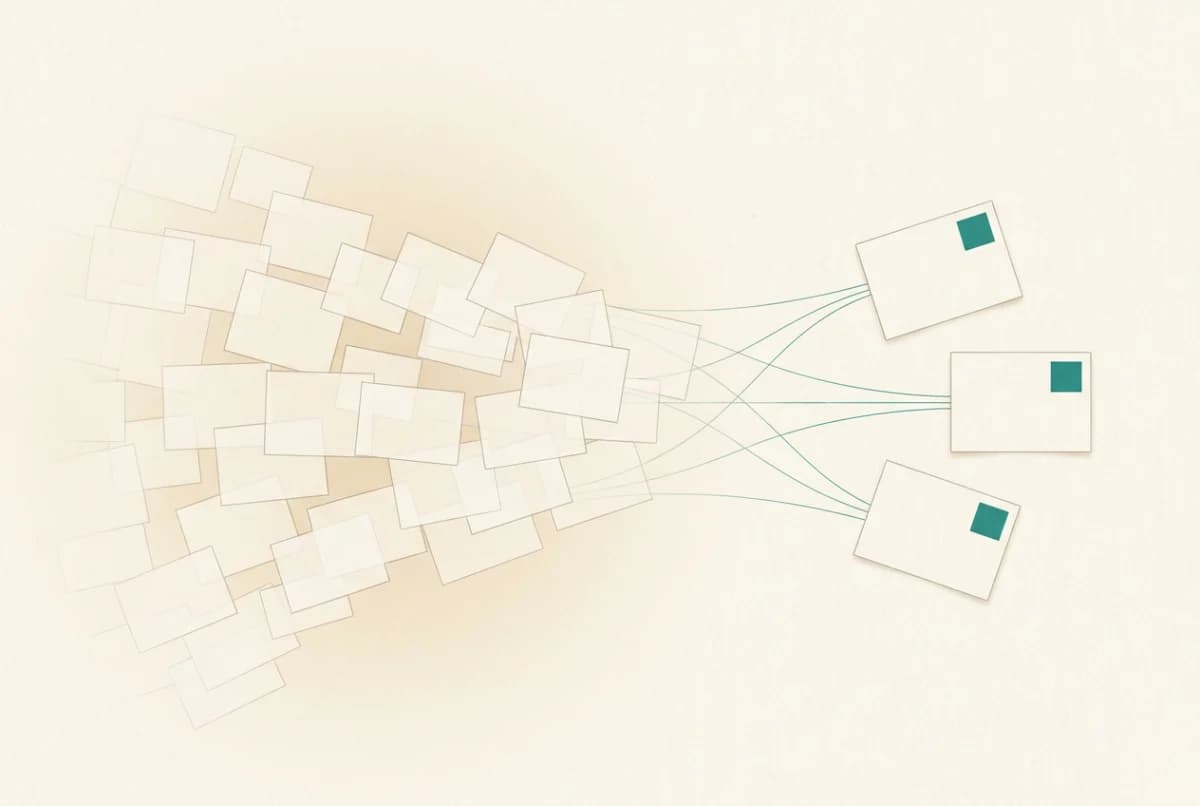
Context rot is the accuracy drop language models suffer as input grows, long before the window fills. At 32,000 tokens, 11 of 13 models scored under half.
Read the article
Give AI the right context
AI forgets because each chat starts blank and only sees what fits its context window. The fix: give it persistent, retrievable, cited context from your own documents.
Read the article
What is AI context
AI context is the background information, your documents, history, and instructions, that a model reads to produce relevant, accurate answers. Here is how it works.
Read the article