AI meeting notes are only half the job. The other half is being able to check them
AI meeting notes solve a measured problem: Microsoft's Work Trend Index found the average employee spends 57% of their time communicating in meetings, email, and chat, against 43% creating. Automatic summaries claw that time back. But a summary you cannot trace is a new risk wearing a productivity costume: decisions get misattributed, commitments drift, and the record everyone relies on was written by a model that paraphrases confidently whether or not it understood. The fix is the same as everywhere else in AI: link every line of the summary to its source.
Updated
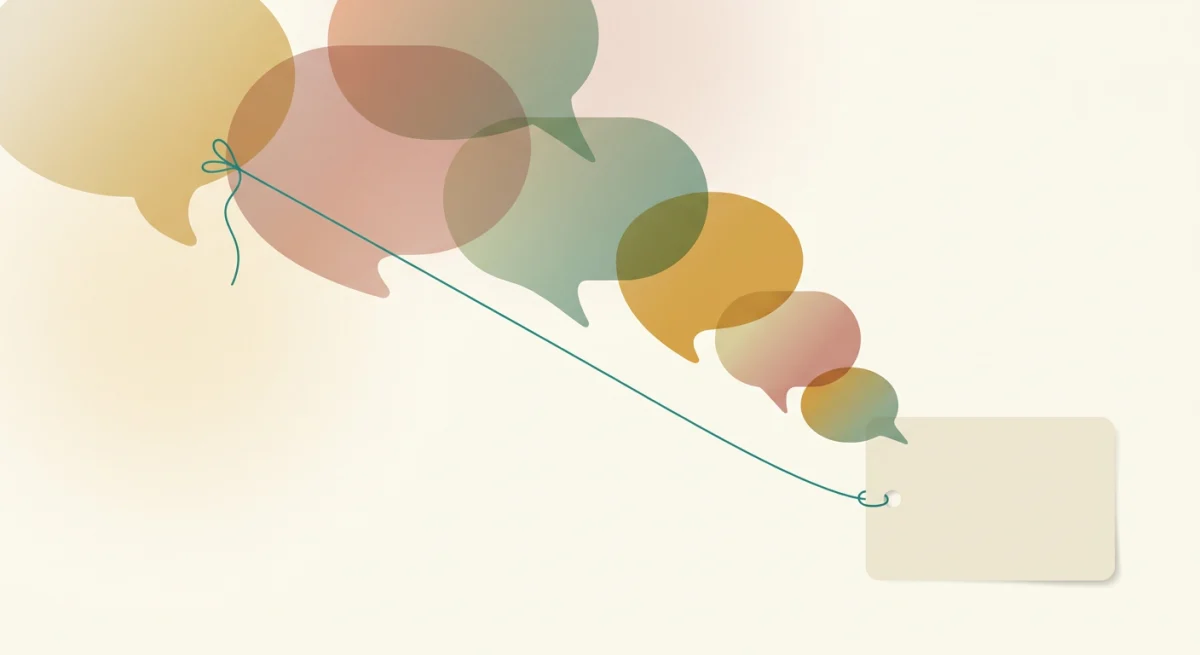
Why meeting notes became an AI product overnight
The demand is not mysterious. Microsoft's telemetry across its own apps found employees spending 57% of their time in meetings, email, and chat, and only 43% in focused creation. Every hour of meetings also produces follow-up work: minutes, action items, decisions to circulate.
Transcription plus summarization automates almost all of that mechanical layer, which is why every meeting platform now ships an AI notetaker. For low-stakes syncs, any of them is fine. The interesting questions start where the notes matter: decisions with money attached, commitments to clients, disagreements someone will later relitigate.
The failure mode: a fluent summary of a meeting that did not happen
A summarizing model has the same property as every other language model: its output reads fluently whether it is faithful or not. In meeting notes this takes specific forms. An exploratory "maybe we should" becomes a decided action item. A concern raised by one person is attributed to another. A number said once, misheard by the transcriber, propagates into the record.
These errors are invisible in the summary itself, exactly like a fabricated citation in a research answer. The only place they are visible is the transcript, and a summary that does not link to the transcript quietly asks everyone to trust it. Peer-reviewed testing of generated references, where GPT-4 fabricated 18% of citations, is a reminder that fluency and faithfulness are different properties.
What verifiable meeting notes look like
The design target is simple: every consequential line in the summary, each decision, action item, and attributed statement, links back to the moment in the transcript it came from. Reading the notes, you click any claim and see who actually said what, in context.
That one affordance changes the failure economics. A misattributed decision gets caught in the five seconds it takes to check, instead of in the meeting three weeks later where two people remember different commitments. And the notes become durable knowledge rather than a loose artifact: a record you can question later, with the evidence attached.
From meeting notes to a queryable record
The bigger unlock is what happens after the meeting. Minutes, transcripts, and decisions accumulate into exactly the kind of corpus that grounded AI is good at: a private, permissioned library you can ask questions of. What did we decide about pricing in March? Which client meetings discussed the renewal? What did we promise before the contract was signed?
In Tatsulok, meeting records live alongside your other documents, and answers to questions like these cite the exact passage, in the minutes or the transcript, that supports each claim. The meeting stops being something you attended and becomes something your team can verify against.
Choosing a setup: three requirements
1. Source-linked summaries. Every decision and action item in the notes should trace to the transcript moment. A summary without anchors is an opinion with formatting.
2. A real library. Notes that die in a chat thread or an email are write-only. They belong in an organized, searchable, permissioned collection with the rest of your team's knowledge.
3. Honest gaps. When the record does not contain an answer, the tool should say so. An AI that improvises the missing part of a meeting is manufacturing institutional memory, and that is worse than having none.
FAQ
- Are AI meeting notes accurate?
- Transcription is now strong, but summarization inherits language-model behavior: fluent output that may drift from what was said, misattribute statements, or upgrade suggestions into decisions. Accuracy you can rely on comes from summaries whose every line links back to the transcript for one-click verification.
- How much time do meetings actually consume?
- Microsoft's Work Trend Index measured the average employee spending 57% of their time communicating, in meetings, email, and chat, versus 43% creating. That is the time AI notetakers target, and why they spread so quickly.
- What is the biggest risk of AI meeting summaries?
- Silent misattribution: a decided-sounding action item nobody decided, or a statement attributed to the wrong person. These errors read fluently and only become visible against the transcript, which is why source-linked notes matter more than summary quality.
- Can I search across past meetings with AI?
- Yes, if your notes live in a grounded library rather than scattered chat threads. In Tatsulok, meeting minutes and transcripts sit alongside your documents, and questions like "what did we decide about the renewal" return answers cited to the exact passage in the record.
- Should meeting notes be private?
- Treat them like the confidential documents they are: they contain unreleased plans, personnel matters, and client information. Prefer tools with private-by-default storage, explicit sharing controls, and clear terms on whether your data trains models.
Sources
Related guides
Propose, don't apply
The propose-dont-apply pattern: AI suggests changes as visible proposals, a human accepts or rejects each one. Why it beats silent automation for contracts, research, and anything you sign.
Read the article
Glean alternative
A Glean alternative focused on cited, verifiable answers from your documents and access-controlled sharing, rather than a company-wide SaaS search deployment.
Read the article
Team AI verification flow
58% of employees use AI output without checking it. A team verification flow fixes that with three tiers, clear ownership, and tooling that makes the check cheaper than the skip.
Read the article